
The Canadian Minister Who Learned Politics in Haiti
Jean Numa Goudou ·
"Everything I say, I stand by," declares with bursts of laughter the Deputy of Papineau, Marjorie Michel, whom we meet for this profile.
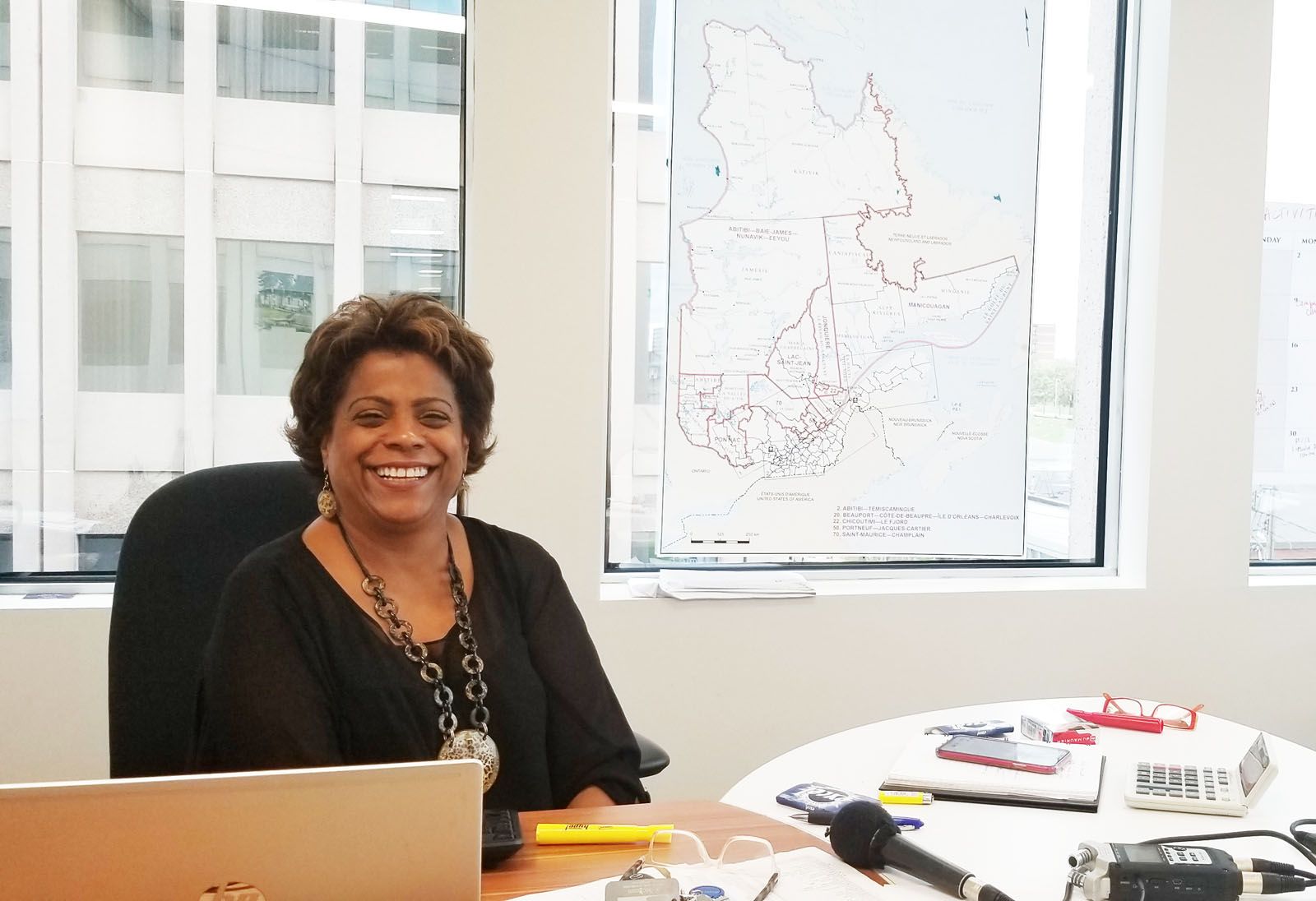
"People criticize me for giving my phone number to just anyone, but that's who I am," says the Canadian Minister of Health.
Ms. Michel, unlike many women, has no taboo about her age. "Not at all, in 1963, I'm 62 years old and I'm very happy to be this age. I wouldn't want to go back to 40," she says with the hearty laugh she's known for.
Born in Haiti, she lived there until age 17 when her father, Smarck Michel, a prosperous businessman, sent her to Quebec for studies.
She enrolled in CÉGEP. "I must tell you that I hated it," notes Ms. Michel, "because I couldn't adapt to the individualism. I was raised in a large lakou (in community)." For two years she didn't meet anyone, not even her neighbors. She tried to adapt by attempting to ski "nothing worked."
It was her sister, already in Belgium as a student, who convinced her to come join her after college. The two studied Psychology in Brussels. It was 1987. She specialized in Social Psychology and Work Organization.
While she found a job after her studies, one morning, her father showed up in Belgium, unannounced. "He had come to tell me that he had sweated his whole life at the Croix des bossales (a public market in Port-au-Prince) so that his children could have a quality education, but that it was ultimately to give back to the country," explains Ms. Michel. A daddy's girl, "I told him perfect and I followed him."
More Political Than Her Father
It was the 1990s. Haiti was experiencing democratic fervor and preparing for elections. Marjorie Michel worked at the Provisional Electoral Council (CEP) as a volunteer. She would transport ballots to remote regions of the country, sometimes under gunfire, in her small car. Then she worked as a polling station manager.
While her father was prime minister in Haiti (November 1994-October 1995), Marjorie Michel swears he wasn't a politician. "My father didn't do politics," she says, "he was a socially engaged businessman who wanted his country to change. I'm more political than my father."
He had been imprisoned at "Fort Dimanche" under Duvalier, "but we learned it was another jealous merchant who wanted to harm him." He got involved in "La famille c'est la vie," an orphanage set up by Jean Bertrand Aristide that welcomed street children.
That's how Marjorie Michel found herself in J.B. Aristide's entourage, eventually organizing his 1990 presidential campaign. She was 26 years old. "I didn't really like it, but that's what they wanted me to do," she says.
The priest from Saint-Jean Bosco won and Marjorie Michel had to manage the swearing-in preparations, including the participation of 800 grassroots organizations across the country. "Some saw me as a bourgeois woman who had no business being there," she recalls, "but I held firm."
"It's Haiti that trained me. I learned certain things here. But it's my country that trained me in political organizing," she says with pride.
Return to Canada
Eight months later, a coup d'état overthrew Jean Bertrand Aristide. Marjorie Michel, like many others, left the country for exile. She returned in 1994 to prepare the priest's return to power, with American help, in 1994. After that, it was the beginning of a long decline for the country.
In 1998, suddenly, her father gathered the family and told them: "I'm so sorry. What this country is going to become, I haven't prepared you for it. You're going to have to leave." Marjorie Michel, once again, listened to her father. She tried to go to France before choosing Canada. Thanks to her academic credentials, she was recruited in 15 minutes during a meeting at the embassy and her Quebec Selection Certificate (CSQ) was delivered to her in person.
"That's how it worked back then. It seems the world has really changed," murmurs the federal Member of Parliament for Papineau. She worked in community organizations in greater Montreal and no longer wanted to do politics, especially not anything related to Haiti or Haitians.
Drawing from Her Community
It was her meeting with the former MP for Viau and Bourassa, Emmanuel Dubourg, that brought her back into it. He took six months to convince her to join his team in Viau.
"Since I was very hurt by the experience in Haiti, I didn't want to return to that world with that Haitian complexity," explains Canada's Minister of Health. But that's where she met Justin Trudeau "who gave me the most beautiful gift in politics, the riding of Papineau."
Marjorie Michel has held every position in politics here. Fieldwork, director, public policy, parliamentary affairs, chief of staff, MP and minister. "When people ask me how I did it: I answer, I don't know," she says with a laugh. But in fact, she draws her strength from her community for whom "it's very hard," acknowledges the MP.
Marjorie Michel doesn't hide that fear gnawed at her when she was elected because "I was used to being behind someone, me."
"When I was elected, it was the community's reaction that gave me confidence that I could do it and I am their eyes in Ottawa" -M. Michel.