
Terrebonne or the art of racializing a defeat
Philippe Chancy ·
The problem is that for some, nationalist defeat can never be simply political. It must always be explained by an alteration of the collective body, by a dilution, by a denaturation.
By constantly explaining democracy through demographic fear, we end up no longer believing in political equality for all. There are columns that don't analyze an electoral result: they stage it as an identity wound.
Mathieu Bock-Côté's text on Terrebonne belongs to this category. Under the guise of sociological lucidity, it actually recycles an old political temptation: explaining a defeat not by the limits of a project, a party or a discourse, but by the growing presence of citizens who are deemed, without always saying so directly, less politically legitimate than others.
In his column of April 15, he states that "the essential" is found in "the demographic change of Terrebonne, obviously, under the pressure of massive immigration." He adds that "populations from immigration" would expand the "liberal base."
The most important word here is not "immigration," but rather "obviously." Everything is there. The columnist does not demonstrate: he naturalizes. He does not prove: he suggests. He does not make an electoral analysis; he constructs a reflex. And this reflex consists of transforming a democratic choice into a demographic symptom.
Combat nationalism likes to speak in the name of the people. But as soon as the real people deviate from the script, they cease to be a people and become a demographic problem. That is the truth about this kind of column. While loudly claiming to defend the nation, there is often the more discreet refusal of political equality among all those who compose it.
It's a very particular way of talking about democracy. When the "right" people vote the "right" way, we talk about national conviction. When they vote otherwise, we suddenly talk about demographic transformation. Thus, suffrage remains respectable as long as it perpetuates the desired identity imagination; it becomes suspect as soon as it contradicts it.
This is not just an analytical bias. It's an implicit hierarchy between voters deemed organically rooted and voters perceived as politically exogenous.
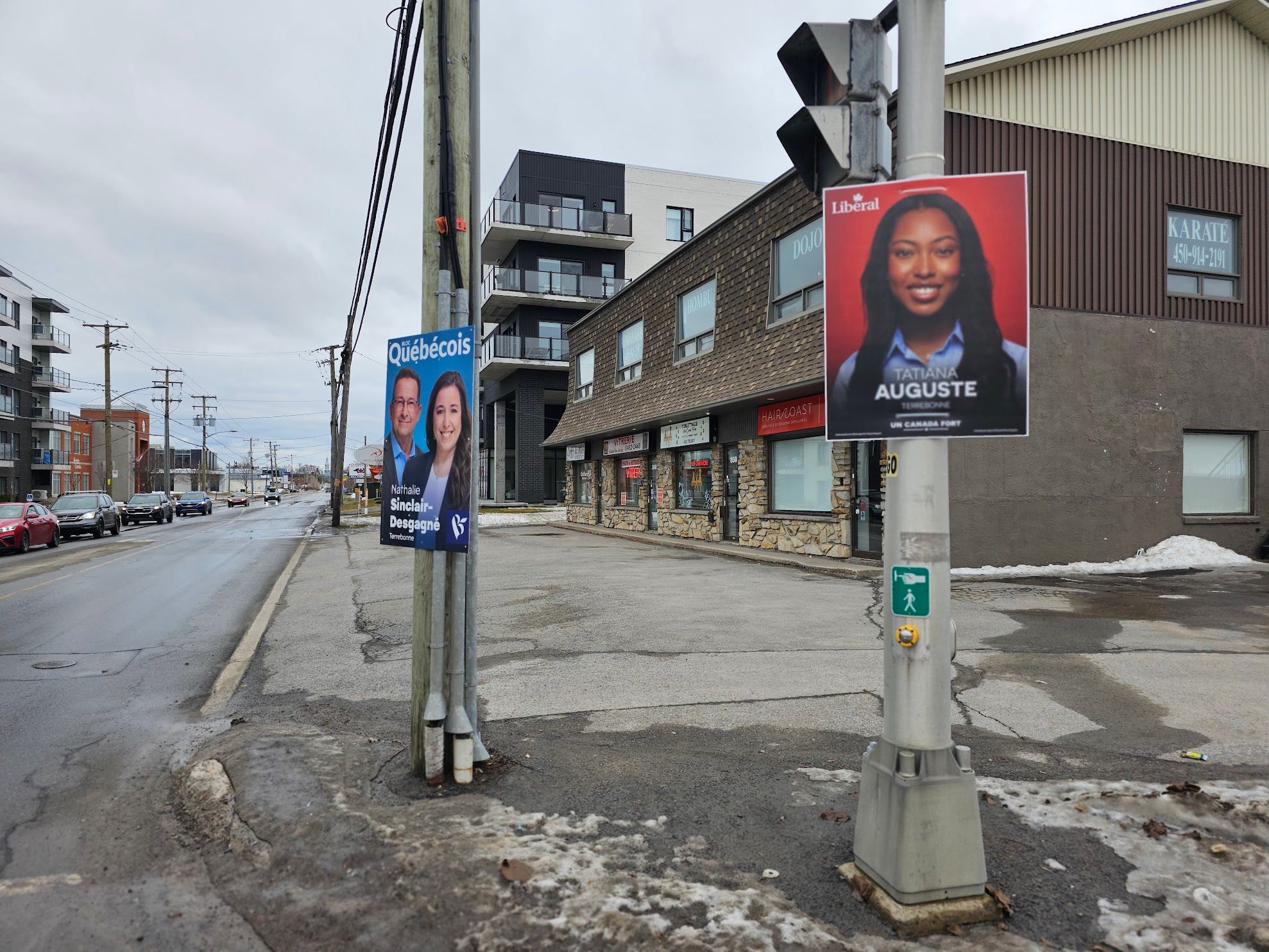
But the facts are much less spectacular than the siege fable. In the federal by-election of April 2026, Liberal candidate Tatiana Auguste won Terrebonne with 22,445 votes, or 48.3%, against 21,777 votes and 46.9% for the Bloc québécois. We are not facing the collapse of a citadel, but a tight race in a highly competitive riding.
Above all, the ethno-demographic explanation brandished as evidence rests on a manifest exaggeration. According to Statistics Canada, the proportion of the immigrant population in Terrebonne rose from 6.5% in 2011 to 12.6% in 2021. This increase is real, but it also means that in 2021, 87.4% of the population was not immigrant. To then present this evolution as the almost sufficient key to an electoral shift is less about reading the numbers than making them say what one wants to hear.
This is the mechanism that must be clearly named. This type of column does not openly say that certain citizens count less than others. It rather says that the country is changing, and with it electoral behavior becomes abnormal. The process is more elegant, more literate, more coded than militant vulgarity.
But it produces the same symbolic effect: it shifts the debate from the political terrain to the ethno-cultural terrain. It no longer asks why a project convinces less; it asks who now composes the electorate. In other words, it doesn't just criticize a vote; it ethnicizes the very possibility of voting differently.
This is where racism conceals itself best: not in crude insults, but in the implicit distribution of civic legitimacy. It doesn't always formulate itself as hatred. It often presents itself as concern, nostalgia, national melancholy.
It doesn't necessarily say that newcomers are inferior; it suggests that they politically alter the "real" people. This kind of racism considers itself too refined to name itself. It prefers the words "lucidity," "historical continuity," "civilization," "national destiny." But its operation remains recognizable: it transforms citizens into variables of disruption.
The problem, fundamentally, is not that Mathieu Bock-Côté worries about Quebec's future. Everyone is free to have their concerns, their loyalties, their attachments.
The problem is that he proposes, once again, a reading where nationalist defeat can never be simply political. It must always be explained by an alteration of the collective body, by dilution, by denaturation.
Nationalism then becomes incapable of self-criticism, because it experiences itself less as a proposition to defend than as an essence to protect. From then on, any electoral setback calls not for strategic revision, but for anthropological complaint.
A mature democracy, however, requires exactly the opposite. It demands accepting that a people is not a fixed substance, much less an ethnic fortress. It is a political community in movement, traversed by disagreements, renewals, contradictions. One does not possess the vote by inheritance. It is obtained through persuasion. And when one fails to convince, there is a choice between soul-searching and denouncing the real people. Bock-Côté's column has made that choice.
We should stop being impressed by the scholarly packaging of this rhetoric. The style is cultivated, the sentence is assured, the historical reference often skillful. But formal elegance does not exonerate a logic.
When one explains a defeat almost primarily through immigration, when one treats civic change as a national anomaly, when one suggests that certain votes weigh differently because they would come from a less authentic Quebec, one is not just making a conservative column. One is participating in the racialization of public debate.
And this is precisely where we must respond, without detour: Terrebonne did not fall. Terrebonne voted. What cracked was not a fortress. It was a narrative that refuses to admit that in democracy, no one has property rights over the people.