
More than 40,000 forgotten refugees in Quebec
Jean Numa Goudou ·
"In terms of identity documents, you only have the letter from the Refugee Status Commission stating that you have been accepted, but that is not proof of identity," notes Ms. Dench.
"It's really excessive," exclaims Marie-Guerline Louimé-Noël, a patient care attendant who has lived in Québec for nine years after spending a year in the United States. Three years ago, her asylum claim was accepted, making her a protected person in Canada.
Ten years ago, she left her five children and her husband in Port-au-Prince (Haïti) and has not seen them since. "They have no pity for immigrants," she laments, "I call regularly, my workplace sends letters, but nothing has worked."
Soyara Silva, an Ecuadorian woman who has been living in Québec for six years, is in the same situation. She is studying industrial relations at the Université de Montréal (UdeM). And the regulations for a student who is also an asylum seeker are very different from those that apply to someone with permanent status.
"I always have to apply for a study permit each time. And the delays have been so long lately that I lost two semesters this year because my permit didn't arrive on time," says Ms. Silva.
"It's hard to wait, to put your life on pause," she adds. "When you become a protected person, in principle, you have a somewhat more solid status here in Canada. But you have nothing to prove it," laments Janet Dench of the Collectif des personnes protégées oubliées, an advocacy group established in January 2026. Recently, the Bureau de la communauté haïtienne de Montréal (BCHM) joined the initiative in order to draw the attention of decision-makers to the issue.
"In terms of identity documents, you only have the letter from the Commission de statut de réfugiés stating that you have been accepted, but that is not proof of identity," notes Ms. Dench.
And so, she continues, "what is somewhat perverse is that we have protected persons asking the government: can I renew my asylum seeker document? Because I need that to have a piece of identification. Then the federal government says: no, you are no longer an asylum seeker, so we won't give you a document. So people find themselves without an identity document. And that, in turn, adds to the complications."
The delays
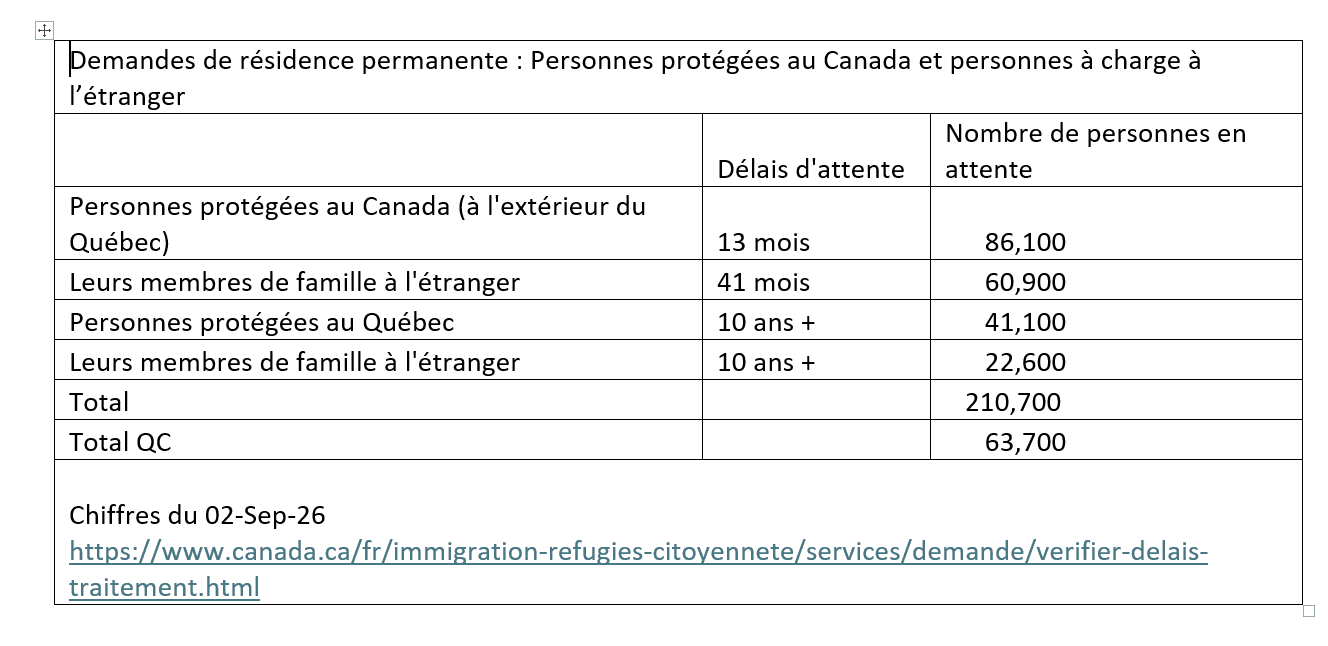
In total, more than 40,000 people have successfully navigated the stressful steps of appearing before a judge at the Commission de statut de réfugiés (CISR) and must now put their lives on pause.
The federal government sets permanent resident admission targets at 380,000 per year for the period from 2026 to 2028, according to the Immigration Levels Plan.
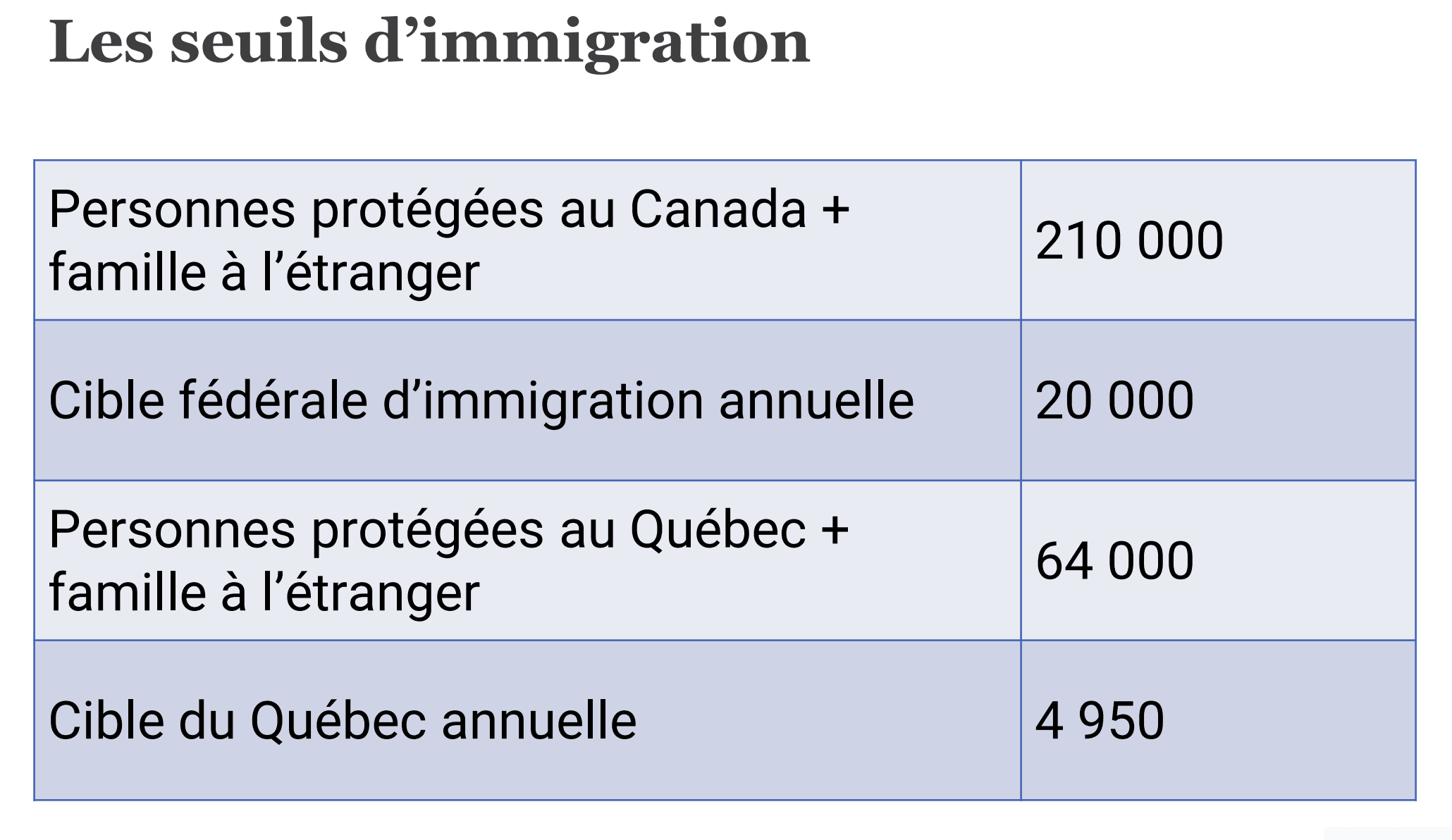
According to a calculation by the Collectif des personnes protégées oubliées, the immigration thresholds are as follows:
Many Haitian individuals are affected by this situation. In 2025 alone, 5,000 Haitian nationals were recognized as refugees by the CISR. Haïti leads all countries of origin for refugees.
There is a Special Initiative for Protected Persons from the federal government, which aims to include 115,000 protected persons and their family members among those who will obtain permanent residence in Canada in 2026 and 2027.
But the catch is that Québec refuses to participate. Protected persons in Québec and their families are limited to annual targets of 4,950, which is why processing delays have been excessively prolonged.
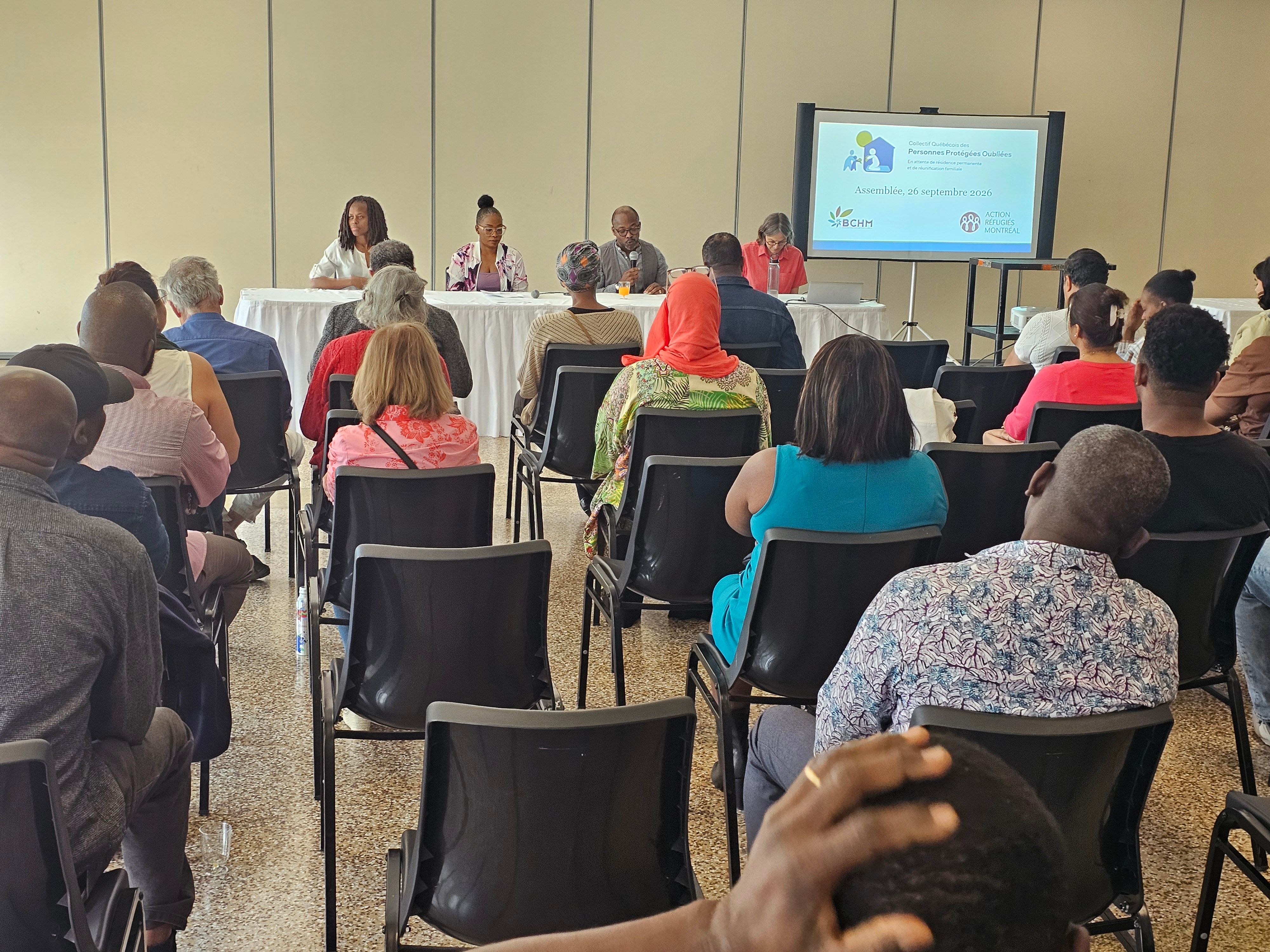
A few days before the October 5 election, the BCHM and the Collectif brought together several dozen protected persons as part of the launch of a mobilization campaign on their behalf. Ruth Pierre-Paul, the executive director of the BCHM, took the occasion to make several requests to the next Québec government, whatever its political stripe.
"To the Québec government, we are asking for three specific things," she said at the outset.
-
First, to include in its immigration planning the necessary spaces so that protected persons living here can fully benefit from this federal initiative, which dates back to last year.
-
Next, to accelerate the processing of files that fall under its jurisdiction, so that Québec does not become the stage where the wait drags on.
-
Finally, to give priority — clear priority — to the reunification of children, because childhood cannot wait.
"We are not asking for compassion, we are not asking for sensitivity. We are asking for a commitment, and a clear commitment," she said. "We want to know what you will do in the first 100 days of your mandate to reunite these families. The people present here are listening to you, and so are their neighbours, their colleagues, and their community."
In addition to the BCHM, the Collectif is supported by Projet pour la réunification familiale des réfugiés (RFR), Espace le Havre, and Action réfugiés Montréal. More than 70 organizations had backed a letter addressed to the ministère de l'Immigration, de la Francisation et de l'Intégration (MIFI) urging it to take part in the federal initiative in favour of 115,000 protected persons in Canada. But Québec has so far refused to do so.
To join the Collectif and register HERE To listen to our podcast with Janet Dench click HERE