
Chrono through Sunrise will operate Montreal–Cap-Haïtien flights by the end of November
Jean Numa Goudou ·
Due to serious security concerns for aircraft approaching the capital's airport, several international airlines have suspended their operations to and from Port-au-Prince.

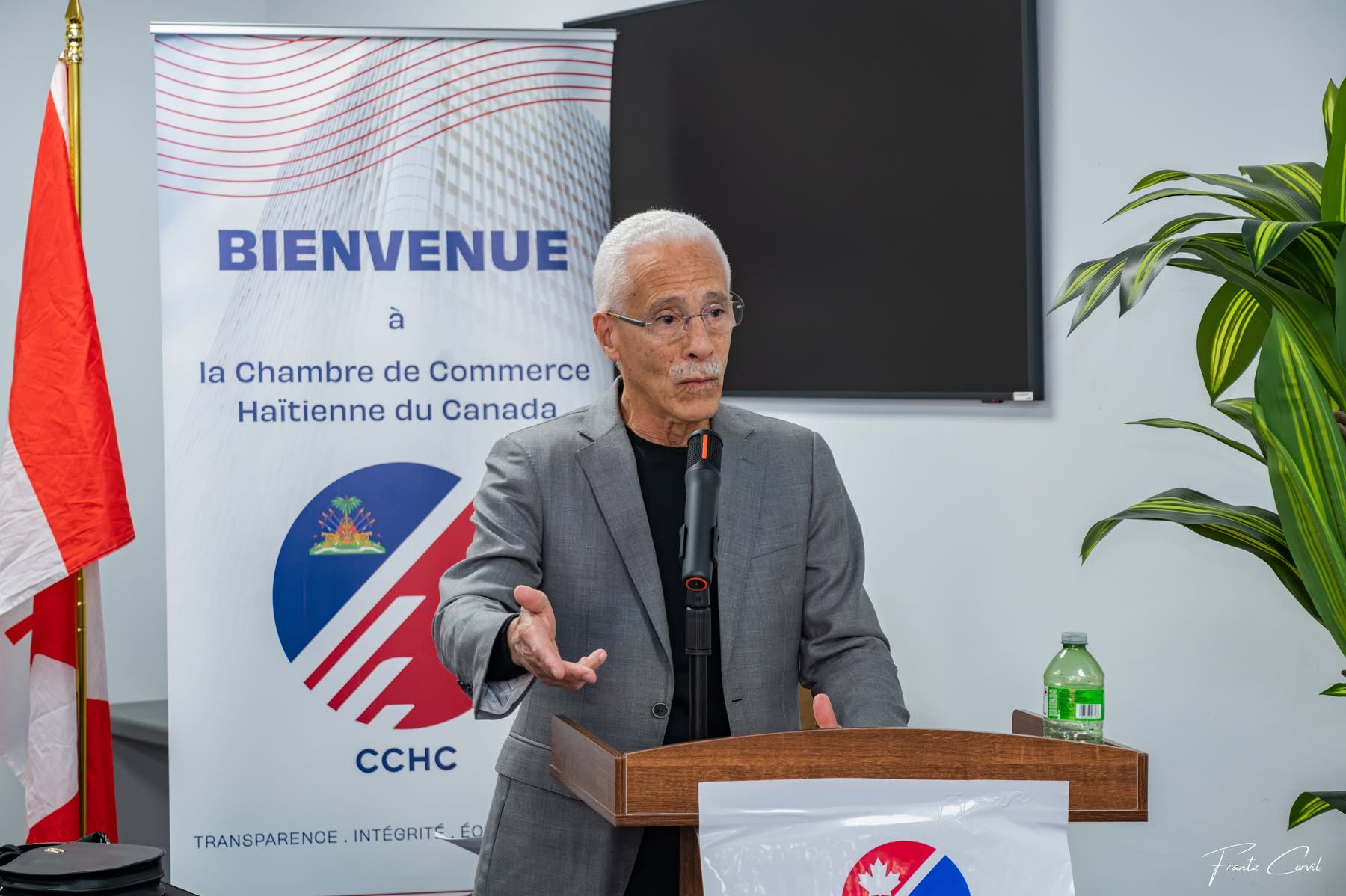
The president of Sunrise Airways, Philippe Bayard, announces the resumption of Montreal–Cap-Haïtien flights starting November 22 at a meeting with entrepreneurs organized jointly by the Haitian Chamber of Commerce of Canada (CCHC), Damesara, and the office of Member of Parliament Natilien Joseph. The flights will be operated by Chrono Aviation through the Haitian airline.
Since September 2025, no air service had been available between Canada and Haiti following the suspension of Air Transat flights for security reasons.
"It is a great pleasure to be with you today and to announce that we will be establishing a connection between Montreal and Cap-Haïtien toward the end of November," said Mr. Bayard before entrepreneurs and CCHC members gathered in Montreal at the Sommet jeunes afros, an initiative by Isaac Bosquet of Damesara.
"I created Sunrise with one conviction: Haiti needs connections to move forward. Every route must enable more encounters, exchanges, and development opportunities," adds the former pilot who became an airline operator in 2012.
Ticket prices are not yet known and will be announced shortly. For ticket sales, Sunrise will work with a Montreal travel agency.
Port-au-Prince and Security
Due to serious security threats to aircraft on approach to the capital's airport, several international airlines have ceased operations to and from Port-au-Prince.
The U.S. Federal Aviation Administration (FAA) has extended its ban on American flights to Port-au-Prince until March 2027. U.S. air carriers, commercial operators, and U.S.-registered civilian aircraft are strictly prohibited from flying below 10,000 feet above mean sea level (MSL) over designated high-risk areas around the capital.
The reason: this requirement stems from serious security risks after several American commercial aircraft — including those operated by Spirit, JetBlue, and American Airlines — were targeted and struck by gang gunfire while approaching Toussaint Louverture International Airport. In total, eight Sunrise aircraft, a Haitian company, were hit by gunfire. "Since last year, the perimeter of the airport has been secured," notes Philippe Bayard. But that refers to the surrounding ground area.
"But the problem," says the Sunrise CEO, "is that during an approach, you fly over Croix-des-Bouquets, for example, and there really needs to be security in place to prevent someone from shooting at a plane."
"We cannot operate international flights, to the United States or to Canada, from Port-au-Prince, as long as the country has not found a solution to the security problem," Philippe Bayard states firmly.
Insurers and the Haitian Government
Just over a year ago, the Haitian government had signed a memorandum of understanding with Sunrise with a view to establishing a line of credit as insurance or guarantee in the event of an aircraft security incident.
The agreement was made for 19-seat aircraft — the same type Sunrise Airways had started flying with in 2012, smaller planes. And the insurance did not cover operations.
"These aircraft are generally insured for $30 million under what is called a 'combined single limit' (CSL) — a liability insurance policy that combines bodily injury and property damage coverage into a single total amount for a single accident.
"What was offered is a standby letter of credit," Philippe Bayard points out, "so Sunrise receives no money." But the problem is that it took many months to put in place. The company had required that the central bank, issuing under authorization from the Ministry of Finance, use a notifying bank, and that the letter of credit be issued by a top-tier international bank.
Why? Because of incidents that occurred under Jovenel Moïse: when the E-Power project was terminated, for example, there was a letter of credit and a mechanism determining how that contract was to be concluded. The government intervened with the bank to prevent the activation of a letter of credit that was irrevocable.
"That makes international operators very wary, because it should not happen; it has completely undermined confidence in the bank itself," laments the Sunrise CEO.
"This process brought us all the way to the beginning of this year. In fact, the letter of credit was issued two months before its expiration. It was therefore valid for two months. And as I speak to you, it has never been renewed," denounces the Sunrise executive.
"Thank you for being able to say that," Mr. Bayard insists. "As we speak, our lawyers have provided everything to the government," he clarifies, "they have never signed. So keep in mind that as we speak, this agreement does not exist. There is therefore no letter of credit. There it is."
State of Emergency and Terrorism
Furthermore, "the coverage amount applies to small 19-seat aircraft. If we need to increase capacity — for example, to operate a flight from Miami — you cannot run Miami–Port-au-Prince with a 19-seater," he says. "You need a large aircraft for it to be economically viable. That is what prevents us from making it happen: we do not have coverage capable of covering 50 seats."
Beyond the security challenges, Sunrise faces rising insurance costs due to the declaration of a security state of emergency for the West (including Port-au-Prince), the Artibonite, and the Centre regions of the country. According to Jean-Sébastien Bayard, Sunrise's Chief Financial Officer, the company must contend with two risk premiums.
"When the Prime Minister declared the state of emergency in Haiti, and then came the declaration that the gangs are now terrorists, we became like Sudan, like all countries at war," he notes.
"It is causing more and more problems," Sunrise's CFO assures. "Now, with the state of emergency covering the entire national territory, Cap-Haïtien also becomes a risk zone. It is a rather complicated sector, and that is why we see that not many airlines are flying."