
Afro Summit: 5 minutes with the Compagnie de théâtre créole
Rédaction Intexto ·
Le Sommet Afro and InTexto are partnering to amplify, through a series of podcasts, the voices of 20 organizations that bring our network to life. Every Tuesday at noon, we introduce you to an organization, its history, its mission, its projects and much more. It all happens here, on In Texto.
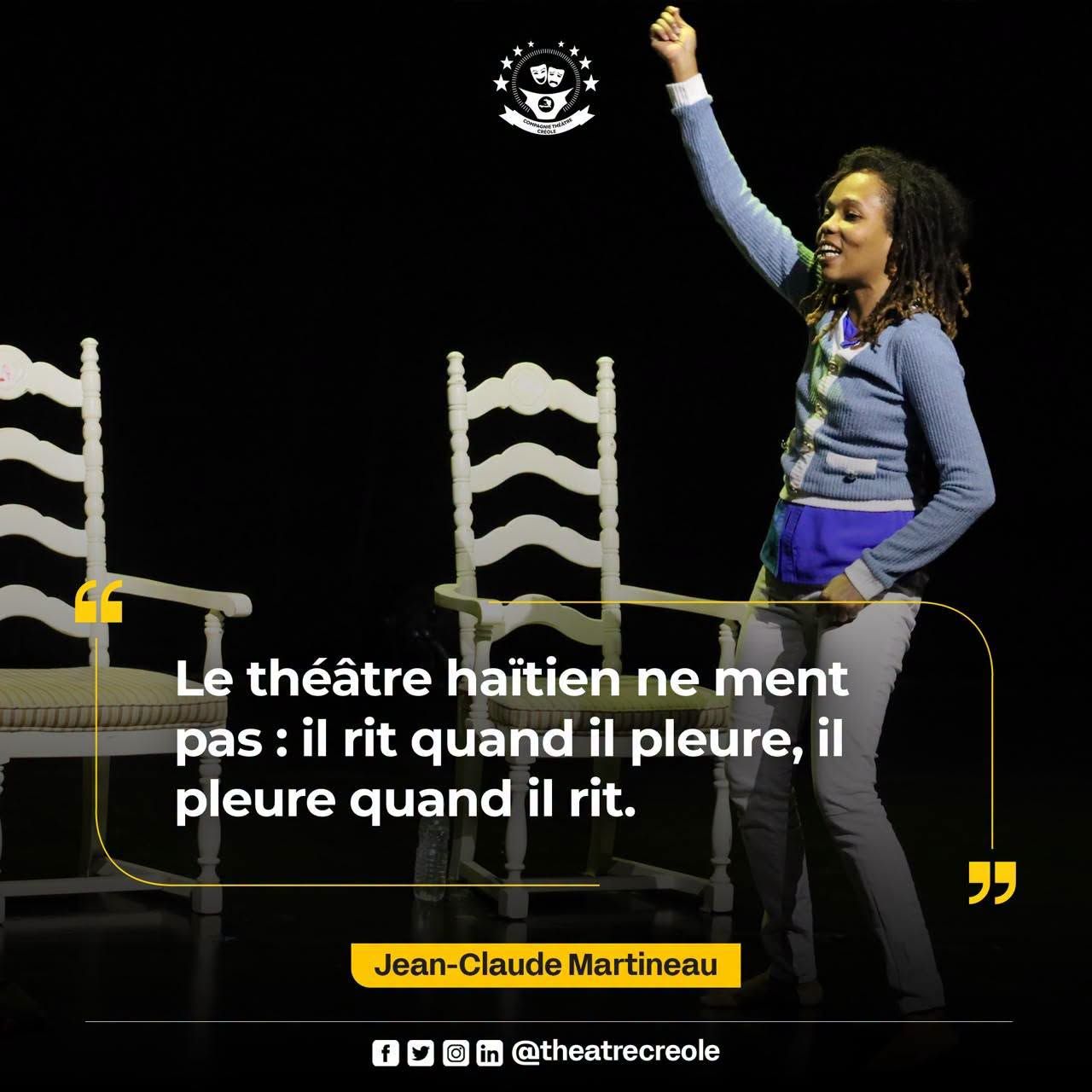
The Sommet Afro and InTexto are joining forces to amplify, through a podcast series, the voices of 20 organizations that bring our network to life. Every Tuesday at noon, we feature an organization, its history, its mission, its projects, and much more. Right here, on InTexto.
Hello everyone, my name is Jean-Numa Goudou. It is Tuesday, September 29, 2026, and we are with Nerlande Gaétan-Civil, from the Compagnie Théâtre Créole, located at 5322 Jean-Talon East Street, in Montreal. And this is "5 minutes with an organization," coming to you right now. Of course, we will be spending a little more than 5 minutes with Ms. Civil, to look at how it all began, where the company stands today, the challenges, but also the projects of the Compagnie Théâtre Créole. But just before that, I'll say hello to Ms. Civil. Hello.
NERLANDE GAÉTAN-CIVIL Hello Jean-Numa, thank you for having us… at the Compagnie Théâtre Créole.
HOST There we go. And just before we begin, we took a little guided tour of your premises. We will invite our listeners to see what you do, who you are and how you do it, through this short guided tour. And it was you who took me on that tour.
GUIDED TOUR — We are at the Compagnie Théâtre Créole's space. This is the sign welcoming us. It is Thursday the 24th… — This is Nerlande Gaétan-Civil. This is your space, here. — That's right. It's Thursday. You have an activity here, it seems? — We have the poetry evening every Thursday starting at 7 p.m. — This is the Richer space… [name to verify]. — Yes. And there's an event here? — Every Thursday evening, when people are here, we celebrate them; of course, we offer them something to eat. — OK. — This is also where some of the magic happens: the reflections… — The reflection, yes. — … we reflect together. — OK. Wow. So, welcome to the Compagnie Théâtre Créole. — This space, the Richer space…, can be set up in several formats. This is a format for a very special evening, because we want to celebrate one of the artists. Otherwise, we have the traditional Italian-style format, where there are just seats, for other types of evenings. So for each type of evening, we rearrange the room. — The space is named after Richer…, who passed away last July. He was an artist with fifty years of career [?], who always loved theatre, who performed in several countries, in French, in Creole, in English. He has left us, and this space is here to celebrate his love for theatre.
— Here is another office of the Compagnie Théâtre Créole, and over there is the library [?] with the lounge.
HOST There you have it, that was the short guided tour at 5322 Jean-Talon East Street. And in the studio, we have with us Nerlande Gaétan-Civil, who is the Programs Coordinator and partner.
HOST Well said. And Ms. Civil generally speaks on behalf of the Compagnie Théâtre Créole.
NERLANDE GAÉTAN-CIVIL For the most part, when people see me, they automatically associate me with the company, but I must say that the original idea for the company is absolutely not mine. I am a newcomer, in fact.
HOST Yes, we'll get to that. But you are a member of the Sommet, the Sommet which today counts more than ninety organizations. And you were there from the beginning, when the Sommet had what, around twenty, thirty organizations?
NERLANDE GAÉTAN-CIVIL Yes, there were even fewer than that, and it will be 10 years. Of course, in January, we were there, attending all the major assemblies, the major meetings. And at a certain point, we remember, in 2024, we raised our hand to say: "And what about culture in all of this?" And of course, with his characteristic openness, Édouard Staco (president of the Sommet Afro), who was chairing the assembly, said: "Listen, bring me your proposals." He always approaches things that way.
He said: "Let's talk about culture, as you wish." And from that moment on, we became part of the committees that discussed culture with artists, here at the Sommet. Even before the room was ready to welcome everyone — the large hall upstairs — we were the first organization for which the Sommet arranged the room, to host our symposium on inclusive theatre.
HOST Yes, I remember that symposium. And that marks your beginnings with the Sommet.
NERLANDE GAÉTAN-CIVIL The beginnings — I wouldn't even say that… It's the moment when the Sommet also fully embraced the issue of culture. The education and housing files were being very well addressed, very well supported. Those related to the health of Black communities were already well underway. But culture was not yet on the discussion table at the Sommet. And ourselves, as a cultural organization that was always there, we saw things happening, and we said: yes, it's true, there is health, but culture is transversal to all these interventions you want to make. And what if you thought about using what we, as Afrodescendants, have as a tool wherever we go? The one thing, in fact, that allows us to shine the most is, first and foremost, our art.
HOST That was your beginnings with the Sommet, I understood. But your own beginnings, as such, started…
NERLANDE GAÉTAN-CIVIL In 1999. It is an organization that is more than 26 years old. It was founded by Ricardo Lefèvre [?], who was first in national television before entering the political sphere — he was first and foremost a television man. Then Ralph Civil, who is, I would say, today the creative mind behind the company.
HOST The artistic director.
NERLANDE GAÉTAN-CIVIL Yes. At the beginning, Ricardo was there, there was Washi [?] Jean-Baptiste; they came together and formed a team to establish the Compagnie Théâtre Créole, which at that time was only a company producing shows. OK. And you immigrated with what basic idea, here in Canada?
NERLANDE GAÉTAN-CIVIL In 2012. Washi [?] was there well before; Ralph joined a little later. And Ralph said to himself: there are many theatres here, but very few French-language theatre companies, and even fewer Black theatres.
There is the Black Theatre Workshop, which has been around for fifty years, in the West, but it is essentially anglophone. From time to time, they offer training for francophones, but it remains mostly anglophone and they work a great deal with Ontario. We wanted something that would maintain a francophone base, that would maintain the Haitian, kreyòl [?] base, the francophone Afrodescendant base. And we noticed that the majority of Black francophones are established in the east end of Montreal.
So we made it our base. Since 2012, we have been established in Saint-Léonard, which is not necessarily an Afrodescendant neighbourhood, but which remains an epicentre from which one can access Saint-Michel, Montreal-Nord, Rivière-des-Prairies, Pointe-aux-Trembles. We are at the centre of all of that. That is also why we positioned ourselves quite strategically along the next metro line, Jean-Talon. We said to ourselves: this is a cultural desert, we are going to bring it to life even before the metro lines come out of the ground.
HOST We'll come back to the topic of cultural desert, but I had a question that was burning on my lips. When you hear "Compagnie Théâtre Créole," it doesn't mean that all your plays are in Creole. It's Creole as in culture?
NERLANDE GAÉTAN-CIVIL Exactly. We have a festival called Festi Théâtre Créole [?]. Because Creole is a language, but it is also a culture, a culture that is shared from one country to another, from one island to another, in different ways. And we like to clarify that Creole is not just a matter of what you eat, nor of a language: it is truly about how you educate people, what you say, what you do. You might come across someone who did not grow up in Haiti, nor in Dominica, nor in Martinique, who has a parent, say, who is Swedish — but if they have Creole origins, even just a Creole-speaking grandmother in the family…
… the child will be raised in a very, very different way. You can feel it in the upbringing, in the onomatopoeia used in a Creole family; you feel it right away. So it is not just a question of language. The Compagnie Théâtre Créole presents a festival in Creole that celebrates Creole cultures starting October 28, the International Day of Creole Languages and Cultures, for one week. But we also have the Théâtre des Noirs [?] festival —
— a festival for the Afrodescendant community, to offer spaces for creation and presentation, something that has always been lacking for Afrodescendants. It is a space for all Afrodescendants, from Togo to Mali, through Burkina Faso: as long as you are here, you are an Afrodescendant. Or even if you are not necessarily an Afrodescendant, but the cause speaks to you.
Exactly. We had a text presented, "Enfantillages" [?], by a French author who fights alongside the Afrodescendant community so that its culture is respected and accepted as it is.
HOST I had a topic I wanted to bring up with you, and you touched on it in part: the state of your situation. How is the company doing?
NERLANDE GAÉTAN-CIVIL I would say that, compared to where we were in 2012, the company is doing well, but not yet as well as we would like. Why? When we held the symposium on inclusive theatre here at the Sommet, it was because we needed to talk about it, to put our finger on the problem, to look the arts councils in the eye and ask them: "Your so-called peer evaluators, where do they come from?"
The answer was very uncomfortable: "We don't know." They did not know how many peer evaluators from the Afrodescendant community they had, across all disciplines, and especially in the field of theatre.
HOST Since then, have there been any advances?
NERLANDE GAÉTAN-CIVIL Exactly. At the symposium, we invited them. They came, they answered questions. There were exchanges with artists, debates…
… the Sommet published a report on the matter, and then we started to see some openings. They said: "Listen, you can become peer evaluators yourselves; we didn't know the Afrodescendant community was interested." The reason is simple: Black artists are often considered amateurs, not professionals, by the arts councils.
HOST As amateurs.
NERLANDE GAÉTAN-CIVIL As amateurs, because they say that naturally, we are gifted, that art and culture are in our blood.
And it was a discourse… You may know how to sing, but if you don't make this craft your livelihood, then you're just doing it for fun. So they thought that a guitarist or a stage director was doing it just for fun. We had to present to them…
HOST That's what they call amateurism.
NERLANDE GAÉTAN-CIVIL Yes, exactly. We had to present to them Ralph Civil who, upon arriving in 2012, already had more than 25 years of career under his belt. And they would say to him: "Can you go run a workshop?" He would answer: "Listen, I could teach any CEGEP student you have, any person with a bachelor's degree. I have my background: I was in France, in Mexico, in Africa, I was trained…
… I am not starting over from scratch. I will offer you what I have, I will wait as long as necessary, but you will come to me." Because, in fact, at the Compagnie Théâtre Créole, we work on ethnodrama. Very few people, throughout the world, continue to work on ethnodrama. Why? People tend to think: you put a tchatcha, you put a drum in a play, and that's it — it represents the culture, it's Afrodescendant, it's voodoo. Ethnodrama goes beyond that.
It reminds us that it is not just a trance dance in a theatre production that makes a show representative of Afrodescendant culture.
HOST So, with that battle, if I understand correctly, the difficulties are fewer for you today, or are there still some?
NERLANDE GAÉTAN-CIVIL There are still some, because not all doors are open yet. We are still at the stage where we have to make ourselves accepted because we are different.
We can still thank Mr. Trudeau: there was this whole momentum toward diversity and inclusion. But this momentum was somewhat of a double-edged sword. Major institutions opened small windows to let in one or two people of their choosing from the Black community, and show us — the broader Black community: "Look, we are inclusive.
… we receive funding." Even when there is a call for projects launched today, everyone is proud, but we are not clear-headed enough to say: nearly 400 theatre companies, mostly with their own venue, plan their seasons two or three years in advance, and slip in one or two Black artists of their choosing, often born here. Those who were born outside of Canada are… … automatically excluded. So it becomes more and more complicated. And when we discovered that there was the Théâtre de la Sentinelle [?], we were very happy to know that there were other institutions. We started coming together, talking to one another, and telling ourselves that it was time to create a presentation space. Because that is what artists are missing: to create, you need to know where you are going to perform. Otherwise, you no longer feel like creating…
HOST Today, your presentation space — is it the premises we visited?
NERLANDE GAÉTAN-CIVIL That is the purpose. It was, I would say, the step after the festivals. We established the festivals. We also have "Absolument femmes" [?], which was truly a space, a cocoon, just for women artists and artisans. But we said to ourselves: OK, now…
… that we have the festivals, we put out calls for projects six months in advance, and artists tell us: "But with what are we going to create? Where will we rehearse?" Even if I have 15 or 20 pieces, rehearsal hours, renting a space — it costs money, I have to pay the fees. We say: "We pay the presentation fee." Yes, but who is going to pay for the rehearsals? Where will I rehearse? What do I give them to eat and drink? So all these elements…
… led us to say that our work is not finished, if we are not able to encourage people who are jumping ship. We realize that Festi Théâtre Créole is the only Creole theatre festival in North America, but it is difficult to find creators. Not because no one speaks Creole, but first because people are considered amateurs, which discourages them. They don't have the means to create, because creation is a process that leads to presentation. Our festivals are a presentation space; the person must first go through the creation and production stage.
HOST So they have a framework, and if you don't fit into it, you have to figure things out on your own…
NERLANDE GAÉTAN-CIVIL That's it, when you don't fit the mold. Exactly. And then the option you have — and I think people need to be clear-headed enough to realize it — is to give away your play. You lose the motherhood or fatherhood of your play, and you become an extra.
HOST So, how do you manage? Does the Compagnie Théâtre Créole manage to get by? Do you manage to take that shortcut? Is it worthwhile for you, since you don't fit the framework?
NERLANDE GAÉTAN-CIVIL We try. It is not worthwhile financially, but it is a risk we decided to take. Our artistic director, Ralph Civil, decided to be patient. It won't happen very quickly, but he will get there nonetheless: making the work we do known, little by little, showing people that the Compagnie Théâtre Créole is not just about plays in Creole — it is first and foremost a leading institution that should be contacted when speaking about diversity. And no one else can speak about us around tables in our place. We decided to take our seats, whether at the Conseil québécois du théâtre or when it comes to peer evaluators. We decided to no longer let others speak in our place, to take the place that is rightfully ours.
HOST Do you have projects for the future?
NERLANDE GAÉTAN-CIVIL The biggest project is to support artists. We have set up what we call an incubator, because we have an aversion to that word "amateur." We want people to understand that being an artist — yes, it's true, you often have to have another job to support yourself, whether you are Black, Latino, or otherwise. Even for those who were born here, as they are called, it is difficult; it is the cultural sector itself that is difficult. But you need to know that spaces for creation exist, that there isn't just a small diversity fund within a committee, that all funds are accessible to us and that there will be no quota… … that it is not our skin color or our name that will matter. That is what we are defending. We are waging a battle that, in our view, must be continued, as is the case in all areas for Afrodescendants. And we want the incubator to return. This incubator allows artists to professionalize, to work with people who have succeeded within the system, whatever their color, who tell them: here is the path to take, and here is how you can enter not just the mold, but the framework.
HOST You already had this incubator, which has stopped?
NERLANDE GAÉTAN-CIVIL We launched it almost for Black History Month. Then we launched our space last July. We started online, because we didn't have the means to have a space. Then we said: let's take the plunge. We take a space, we set it up and we welcome people. We have poetry evenings every Thursday… … people can come and share texts with us, talk about literature, about the challenges facing artists, from 7 p.m. until late. And now, we offer the space to artists. We tell them: come, this is your home, come and create here so that you can eventually participate in the festival. Because we realized that if I am only a festival that… … presents work and waits for plays to be brought to me to showcase, my festival will die, because I have not addressed the root of the problem. It's not just about putting on shows. We also create one show in Creole and one show in French per year. But for that, we must pay the artists; we have no choice. To be recognized as a professional, you have to do it while being remunerated. It is a requirement.
HOST If I understand correctly, you are currently seeking funding for your incubator, because it is not funded and risks dying?
NERLANDE GAÉTAN-CIVIL For the second edition, no one has yet raised their hand. No institution has yet said: "Yes, take another fifteen or so artists and bring them to a professional level, so they can live from their art." That is the most…
… important thing. Instead of just doing small projects and saying: "I am inclusive, I included a Black person in my show," what we want is to enable the empowerment of artists. It's not about telling them: "Here is your fish, and next year we'll see." It's about telling them: "Look, the fish is over there."
HOST I'll teach you how to fish.
NERLANDE GAÉTAN-CIVIL Go ahead, go fish. We tell them: what you have is talent. It is not charity that you are asking for. I am going to show you how your talent can be a tool to sustain yourself and your family.
HOST There you have it: Nerlande Gaétan-Civil, from the Compagnie Théâtre Créole, as part of "5 minutes with an organization." I knew I wouldn't be able to spend only five minutes with her, because, look at how she expresses herself — it's quite something. And I imagine she still has a great deal more to say.
NERLANDE GAÉTAN-CIVIL Absolutely. Thank you for the time given. And I hope that if people feel like discussing further and coming to share their concerns with us — because we will carry them a little further, we will not rest on our laurels — come and see us. We are open every day, Monday through Sunday in fact, because that is where our rehearsals take place; we bring the artists in. 5322 Jean-Talon East Street. And the Thursday poetry evenings are a standing appointment.
It is open to everyone, children and adults alike.
HOST Yes, but if the person cannot come in person, you have an email address and a phone number as well, I imagine?
NERLANDE GAÉTAN-CIVIL Absolutely. By email: compagnietheatrecreole@gmail.com; our website: compagnietheatrecreole.ca; and 514 962-1513 to reach the company. On all social media, we are "Théâtre Créole."