
(Audio)-5 min with the organization Lakay
Rédaction Intexto ·
The Sommet Jeunes Afro and Intexto are joining forces to amplify, through a podcast series, the voices of 20 organizations that bring our network to life. Every Tuesday at noon, we introduce you to an organization, its history, its mission, its projects and much more. It's all happening here, on Intexto.
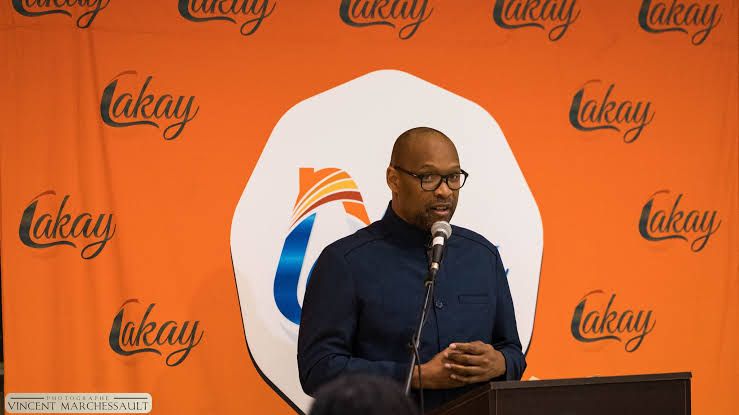
Jean Numa Goudou: Good morning, ladies and gentlemen. It is Tuesday, October 6, 2026, the day after the election. My name is Jean Numa Goudou, but today's podcast is not about the election. This is "5 minutes with an organization" from Sommet Afro, as you just heard. And today is our second episode, featuring the organization Lakay, led by Pierre-Richard Thomas. Pierre-Richard Thomas is joining us remotely today, and we say hello to him. Hello Pierre-Richard, how are you?
Pierre-Richard Thomas: Hello Jean Numa, and thank you for the invitation.
Jean Numa Goudou: There we go. We're going to discuss the organization Lakay, which is headquartered in Repentigny, with its reach extending throughout Montreal, Quebec, and which advocates notably for civil rights — and other things as well, as you'll tell us. You are located at 818 Notre-Dame Street in Repentigny. If you'll allow us, we paid a visit to your offices in Repentigny, and we're going to take a look at how the organization Lakay is set up.
[02:30] Office tour (video)
Jean Numa Goudou: The director — this is his office here. Well set up, he is. Lakay is Lakay, as they say. So we're doing the guided tour: aside from your office, you also have a conference room. A small library here, with books about the Black struggle. All of this is Black literature.
[Brief exchanges during the tour: "Black organizations? — Yes."]
Jean Numa Goudou: We're finishing the tour. Hello! Everything going well? The employees here are well set up. So there you have it, that's our guided tour of your offices. Very well appointed.
[05:00] The origins of Lakay
Jean Numa Goudou: So, let's talk about the organization itself, with Pierre-Richard Thomas, who is joining us remotely. Last week, we welcomed the Compagnie de théâtre créole with [name to be verified], who was in the studio. But technologically, we can also welcome organization leaders remotely. So, where did Lakay come from? Pierre-Richard Thomas, tell us.
Pierre-Richard Thomas: Actually, Lakay started from a simple observation: that we are unfortunately very [underrepresented]. When people talk about us — when I say "us," I mean our Black communities — on television, in the media in Quebec, they talk about us in a certain way. After a while, Lakay changed its mission, because what the communities were asking for was really related to profiling, related to discrimination. We said to ourselves: okay, all these people, yes, we want to show them in a different light on television, but they also have needs. What were those needs? It was to defend them, to defend their rights, to support them, whether in cases of racial profiling, etc. Next year, it will be our 20th year in existence.
Jean Numa Goudou: 20 years?
Pierre-Richard Thomas: Yes. Next year, we'll be celebrating our 20th anniversary.
Jean Numa Goudou: You've been at the forefront of civil rights struggles for nearly 20 years, particularly in Repentigny, on issues of racial profiling?
Pierre-Richard Thomas: Indeed, we've been working on racial profiling in Repentigny for about 10 years. But for the 10 years before that, we were already working to raise awareness, giving talks in schools, making representations, always to defend the image of the Black community.
[07:00] Supporting youth toward employment
Jean Numa Goudou: And apart from civil rights issues, you are apparently focused on youth in particular?
Pierre-Richard Thomas: Yes, indeed. We also provide support to young people in our community, because we now have a project whose goal is to help them return to the job market or to school, as part of a project with the federal government. We work in three provinces: New Brunswick, Ontario, and Quebec. We have about a hundred young people in those three provinces whom we are supporting in returning to the job market. We also have…
Jean Numa Goudou: Speaking of that, I believe there are young people currently in training as part of this program. If you'll allow us, we're going to watch a short video, a brief clip of these young people in training, and then we'll come back with more questions.
[08:10] Video excerpt from the training session (trainer): If we look at the statistics right now, [our parents are not very good at financial management]… If we look at the statistics, we see [inaudible] results, very high [rates], and so on…
Jean Numa Goudou: There you go, that's just to give people an idea of the training these young people are currently receiving, all organized by Lakay. Tell us about this program. It's a program with the federal government, you're telling me.
Pierre-Richard Thomas: It's a program with the federal government aimed at helping about a hundred young people from cultural communities return to the job market or to school. Why? Because apart from the racism we experience in this society, it is very difficult for our young people to find internships after their studies, or simply to enter the job market, despite their qualifications. There are many barriers for us in the community. So we developed this program with the federal government, which will enable these young people to return to the job market.
Jean Numa Goudou: But as you say, "return" to the job market — were they in the job market before? Were there problems?
Pierre-Richard Thomas: Yes, of course. For example, there are young people who were in the job market, and then after a certain period, for various reasons — it could be health, or other reasons — they were unable to re-enter the job market. For instance, I was telling you about the case of a young man who had completed his DEP [vocational diploma], but due to a lack of internship opportunities, he couldn't get his diploma. He spent about two years searching, without obtaining the diploma. Eventually, he came into the program [program name to be verified], and we found an entrepreneur from our community who took him under his wing, who not only helped him complete an internship, but also helped him finish, obtain his diploma and find a job.
What we do is connect these young people with our entrepreneurs, but also with other partners, major players in the system. For example, we work with major players in telecommunications, who allow these young people to work in telephone companies. We also work with organizations in our sector. For example, a young person who has completed a bachelor's degree in communications or IT — it's very difficult to find work in those fields. So we connect them with organizations or partners. The program runs for six months: during the first three months, the young person receives $1,500 per month [in training], and during the following three months of internship, the program pays these young people. So it's a win-win: it's a win for the organization welcoming a young person, and it's a win for the young person, who continues to receive a salary during those three months.
Jean Numa Goudou: There are about a hundred young people in this situation that you are currently helping, in Quebec and in other provinces, is that right?
Pierre-Richard Thomas: There are about a hundred young people in Quebec, Ontario, and New Brunswick currently participating in this program.
[12:30] Civil rights and racial profiling
Jean Numa Goudou: But what about civil rights? Are there struggles you are engaged in? I understand that you focus on youth, you help them. But at the same time, these young people sometimes have problems with the police, problems with profiling, like other people in the Black community. Tell me about that struggle: what is the state of the situation, in your view, according to the organization?
Pierre-Richard Thomas: Well, we of course continue to support members of our community who experience situations of racial profiling, and also to raise awareness in schools, among the police, and in other sectors of the community. For example, last Monday, we were in [Ottawa]. We met with the UN Special Rapporteur, who was visiting Canada. She is expected to produce her report in June, [following her visit] to Ottawa. And we presented an overview of the state of racial profiling and racism in Quebec, specifically in Lanaudière. The mother of Jean-René Junior [Olivier] accompanied us and presented this case before the United Nations Special Rapporteur, and we hope that our voice will carry further in the report she will produce in June 2027.
Jean Numa Goudou: Jean-René Junior [Olivier] was a young man of Haitian origin who was killed by police during an intervention, what, a few years ago?
Pierre-Richard Thomas: Five years ago. It was exactly on August 1, 2021, when his mother had called for help for the mental health issues he was experiencing.
Jean Numa Goudou: Exactly.
Pierre-Richard Thomas: And unfortunately, he was killed by the Repentigny police. That is what the mother explained to the United Nations Special Rapporteur. And we hope that all of these elements will be reflected in the report she will produce in June 2027.
Jean Numa Goudou: Let us recall that the organization Lakay had supported Madame [Olivier] in this case, and for five years now, you have been in contact with her.
Pierre-Richard Thomas: Oh yes, of course. It's not over yet, it's still ongoing, and we hope that she will at least find some measure of justice.
[15:30] The organization's projects
Jean Numa Goudou: So now, what are the plans and future projects of the organization Lakay? What are you aiming for in the future, and do you have hope that the civil rights situation will improve?
Pierre-Richard Thomas: We will certainly work toward that. In our approach, there is awareness-raising, but we also continue to represent and support members of the community. In fact, we have released a virtual reality game, using VR headsets, in which we recreated the cases of victims of racial profiling whose complaints were upheld by the Human Rights Tribunal. We retraced the entire racial profiling process they experienced through a video game, in order to raise awareness among people.
We also have the contest Ma plume contre le racisme [My Pen Against Racism], which we run in secondary schools in the greater Montreal and Lanaudière regions. The fifth edition will begin next week: October 13 will mark the launch of the contest.
Jean Numa Goudou: Students who will be writing?
Pierre-Richard Thomas: Yes, who will participate in this contest. Last year, we had 300. This year, we hope to have at least 500 participants. We published a collection last year featuring the texts, and a second collection will be released next year in March, for the fifth edition.
[17:30] The Projet Famille (DPJ)
Pierre-Richard Thomas: We also have the Projet Famille [Family Project], which supports parents who have issues with the DPJ [Direction de la protection de la jeunesse — Quebec's youth protection services]. We know that there are currently many parents from our community [in this situation]. Moreover, the Laurent Commission [chaired by Régine Laurent] clearly demonstrated that immigrants, especially Black people, are overrepresented in the DPJ system.
Jean Numa Goudou: That's right.
Pierre-Richard Thomas: So we have a program that welcomes parents who want support. We accompany them in the courts, we support them in navigating institutions.
Jean Numa Goudou: These are parents from Lanaudière in particular?
Pierre-Richard Thomas: Exactly, parents from Lanaudière in general. But sometimes, parents in Montreal who have heard about us contact us. We also have partners in Montreal who take over from there. We primarily work with parents from Lanaudière.
Jean Numa Goudou: And you don't only engage in advocacy and activism — you also do prevention and community education on these issues?
Pierre-Richard Thomas: Exactly. In fact, we are currently delivering a series of workshops over five Saturdays, specifically to help people know their rights, to defend their rights, of course, and to understand how the DPJ process works. Because when the school calls you and tells you that the DPJ is taking the children, or placing them for three days, six months, etc., you need to understand the process. So we help people understand that process and also defend their rights.
[19:30] Conclusion and contact information
Jean Numa Goudou: So, Pierre-Richard Thomas of the organization Lakay, thank you very much. I think we've covered all the necessary points. I don't know if there's anything you'd like to add before we wrap up our conversation?
Pierre-Richard Thomas: Yes, I just want to add, for people who hear us and want to participate in our activities…
Jean Numa Goudou: How can they contact you?
Pierre-Richard Thomas: That's right. They can contact us through our website, lakay.quebec. We are very much in need of volunteers for our activities. We also need donations, from people who want to make a donation to us. You can visit our website to make a donation.
Jean Numa Goudou: There you go. And you have a phone number, I imagine, an email? We mentioned the website, but not the phone number or email.
Pierre-Richard Thomas: Of course. People can call us at [number to be verified — heard as "5…4 432-0480"], or write to us at info@lakay.quebec.
Jean Numa Goudou: There you go. Thank you very much, Pierre-Richard Thomas. I'll remind everyone that you are Executive Director of the organization Lakay, which is headquartered in Repentigny at 818 Notre-Dame Street, and which works in Lanaudière in particular, but more broadly throughout all of Quebec, and even across Canada, since there are about a hundred young people in three provinces that you are currently training. Thank you very much, Pierre-Richard Thomas.
Pierre-Richard Thomas: Thank you very much. See you soon.
[21:30] Closing credits
Voice-over: Sommet Jeunes Afro and Intexto are joining forces to amplify, through a podcast series, the voices of 20 organizations that sustain our network. Every Tuesday at noon, we present an organization, its history, its mission, its projects, and more. It all happens here, on Intexto.