
UN Mission in Haiti: about thirty Canadians will be deployed there
Jean Numa Goudou ·
The Gang Repression Force (GRF) has promises of 11,000 troops, twice what the UN authorizes. However, it is three countries, Chad, Sri Lanka and Bangladesh that will provide the military and police personnel that the force needs.
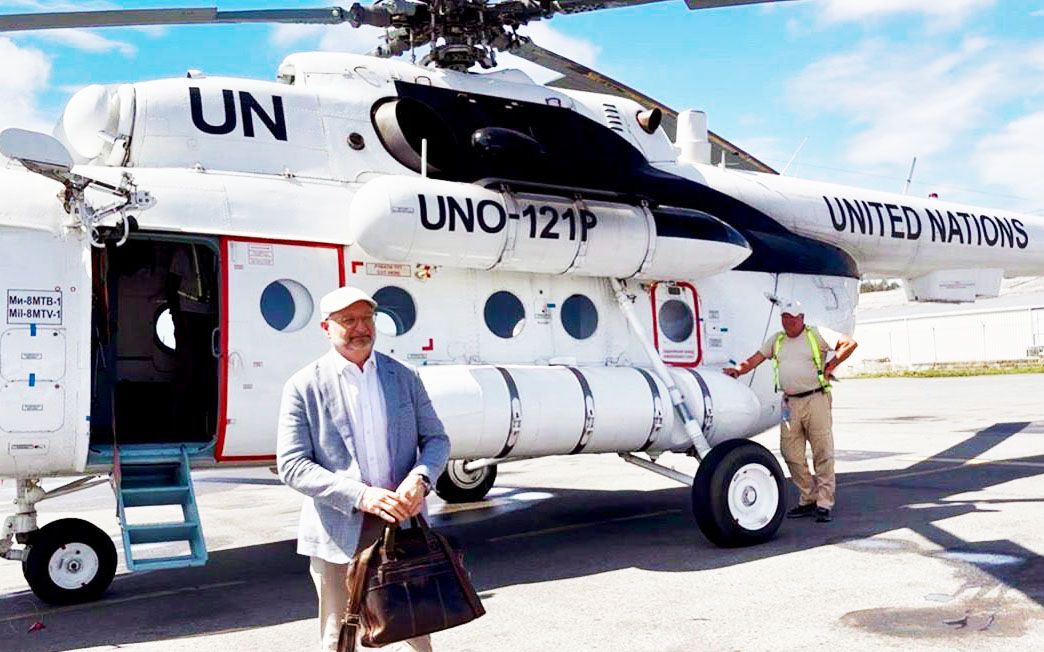
Returning from a mission to Haiti, Canada's Ambassador to the United Nations, David Lametti, displays "cautious optimism" that this time "it could work" in reference to the Gang Repression Force (GRF) that has begun its deployment in Haiti.
In an interview with Intexto, Ambassador Lametti speaks of greater support from the international community than the previous mission supporting the Haitian National Police (HNP).
As proof, he says, the GRF is currently receiving promises of 11,000 troops, double what the UN authorizes. But it is three countries, Chad, Sri Lanka and Bangladesh that will provide the military and police personnel the force needs.
"We had determined that we would need 5,500 agents, that's what we currently have," indicates the Canadian diplomat, "we have other countries that are ready to take over, if necessary. But for now we think it should work with these three countries."
Other countries, like Canada, Jamaica, the Bahamas, El Salvador, Guatemala and the United States are involved financially, technically and at the coordination level of the mission, but will not send ground troops.
Due to training constraints before deployment, the GRF police and military personnel will arrive in phases. By next October, the force will be complete, assures David Lametti. "... And by June, operations should begin," specifies the Canadian diplomat, "everyone would like to see the force arrive now. But it takes training time for troops before sending them."
Canadian troops?
At the GRF office level, of about fifty people, in Port-au-Prince, Ottawa will delegate about thirty Canadians who will work on coordinating operations on the ground. Asked whether Canada was considering sending police or military personnel there, Ambassador Lametti does not close the door, but expresses doubts.
"For now, this is not part of the plan," he says, "we have other promises in reserve. We have given financial support like the United States. Furthermore, there is important support around the world. I believe the world recognizes that something must be done to help the Haitian people."
Between 2022 and 2025, Canada has allocated approximately 425 million dollars to the country. Ottawa largely contributes to the P-4000 Program, a vast project to train new police officers in order to provide the country with 4,000 police officers by 2027.
• The first cohort, composed of 877 officers, including 156 women (35th promotion), graduated on January 23, 2026 after training adapted to the war situation.
• A second cohort of 1,200 recruits just began their training last February
Arms flow from the United States and violence
During the last UN Security Council (SC) meeting on April 23, the head of the United Nations Integrated Office in Haiti (BINUH), Carlos Ruiz Massieu, pleaded for an upstream fight against insecurity.
"We must, at the same time, fight against one of the main factors of violence: the continuous illicit flow of arms and ammunition," declared the UN diplomat from the SC podium.
He affirms that there is a correlation between the rise in violence and the arrival of arms and ammunition in the country. For months, China, Russia and even UN reports have pointed fingers at the United States in this trafficking of arms and ammunition from Miami to Haiti.
"When supply resumes, large-scale attacks follow. This cycle must be broken. Major attacks such as the one that occurred in Jean-Denis (in the Artibonite department) are intrinsically linked to these dynamics," emphasizes the BINUH chief.
Several countries, including Canada, apply sanctions against Haitian political personalities and business figures for their links with armed gangs.
"Sanctions are an essential tool, but however, it is important to intensify efforts to stem these flows that continue to feed the gangs," preaches Mexican Carlos Ruiz Massieu.
"It could work"
Ambassador David Lametti chairs the ECOSOC Advisory Group on Haiti, and in this capacity, he says Ottawa is determined to ensure the success of the Gang Repression Force and help the Haitian people restore security and rebuild their country.
"Lasting stabilization in Haiti will require a long-term, multidimensional and population-led approach," he warns however. This notably involves restoring and protecting essential services — such as healthcare, education, energy and basic infrastructure — so that communities can function safely and with dignity.
"Security operations must be accompanied by detention, accountability and reintegration plans, institutional strengthening, rebuilding trust and supporting lasting peace led by Haitians themselves."
From his mission to Port-au-Prince, David Lametti says he observed better "coordination between the GRF and other UN agencies and a high level of collaboration, an engagement from countries, UN agencies and Haitian police forces (HNP)."
"It could work," this time, believes the Canadian diplomat compared to the various previous UN missions in Haiti.
Let us recall that the violence has caused more than 1.45 million displaced people and plunged 6.4 million people into critical humanitarian needs according to the UN.