
Two "poteau-mitans" of education honored by the Maison d'Haïti
Jean Numa Goudou ·
Ninette Piou, Executive Director of Centre NA Rive, and Suzie Boisrond, a retired teacher and learning disabilities specialist, received the Adeline Chancy award.
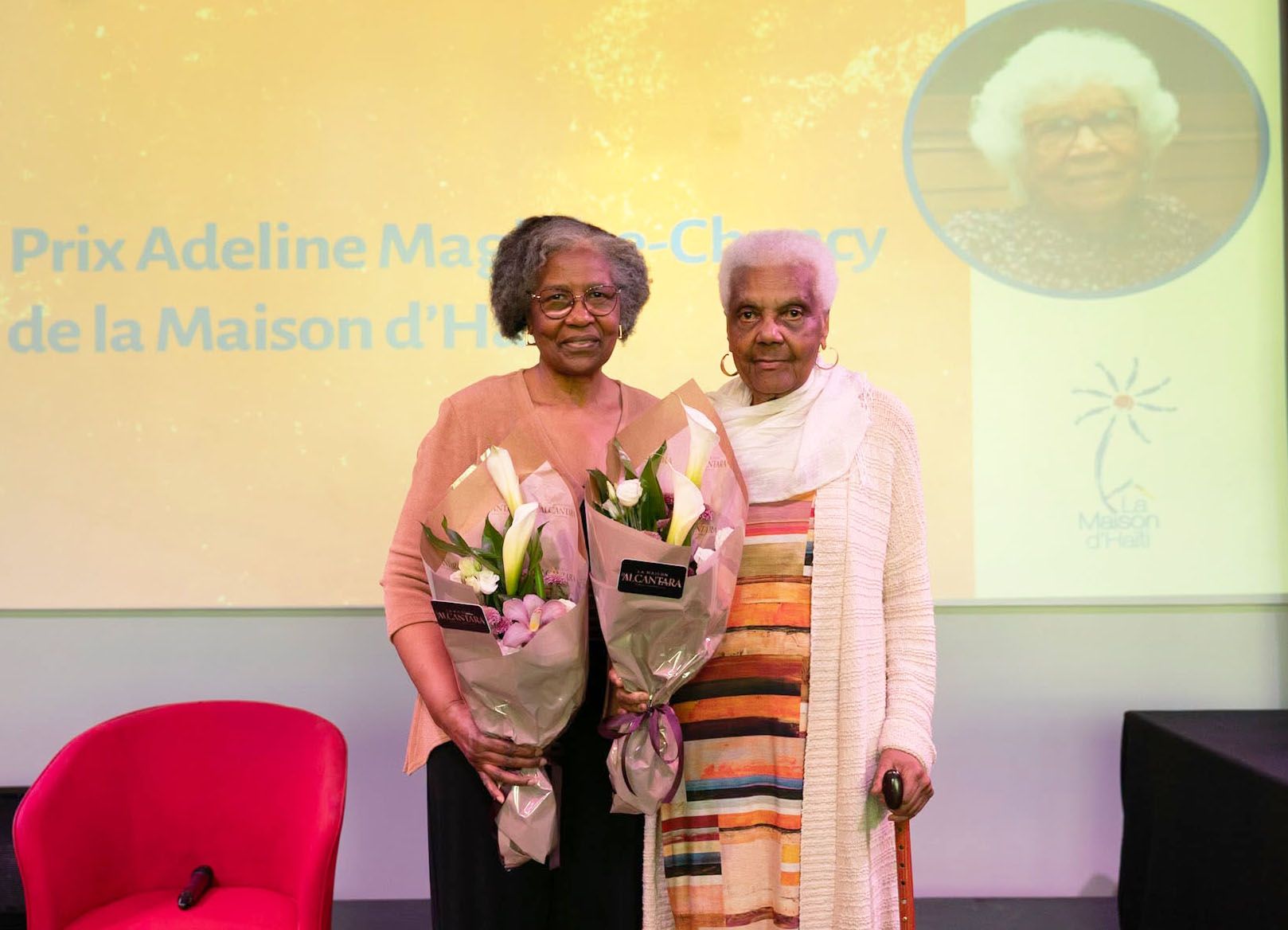
Two teachers of Haitian origin, Ninette Piou and Suzie Boisrond, received the Adeline Magloire-Chancy Award from the Maison d'Haïti on June 26 at a ceremony in Saint-Michel. This Award has just been established, and these "poteau-mitans" of education are the first to receive it in order to "recognize and honor a woman whose leadership and community involvement within the Quebec community make her an exceptional citizen."
Madame Adeline Magloire-Chancy, whose name the award bears, is a prominent figure in the defense of women's rights, literacy, and the promotion of Haitian Creole. A teacher and committed feminist activist, she contributed to the founding of the Maison d'Haïti and fought against racism and exclusion.
Her work has advanced women's rights and the recognition of Haitian Creole. For the inaugural edition, the women who received this award are remarkable. Ninette Piou is the Executive Director of Centre NA Rive, and Suzie Boisrond is a retired teacher and special education specialist.
"No one should be left behind. Education sets you free. The boldness to act and make the impossible possible," stated Ms. Piou upon receiving the distinction. "I thank the Maison d'Haïti for recognizing my commitment to families, particularly to women and children in the community. This means a great deal to me and I am very proud to receive this award," said Ms. Boisrond in turn.
By creating this award, the Maison d'Haïti is recognizing the remarkable career and social involvement of Ms. Magloire-Chancy, noted Arcelle Appolon, Executive Director of the Maison d'Haïti. "Through their perseverance for the causes they champion and their unwavering commitment, these first two recipients have demonstrated the importance of community female leadership as a driver of change," she stated in a press release.
An Award Named After the First "Maison d'Haïti"
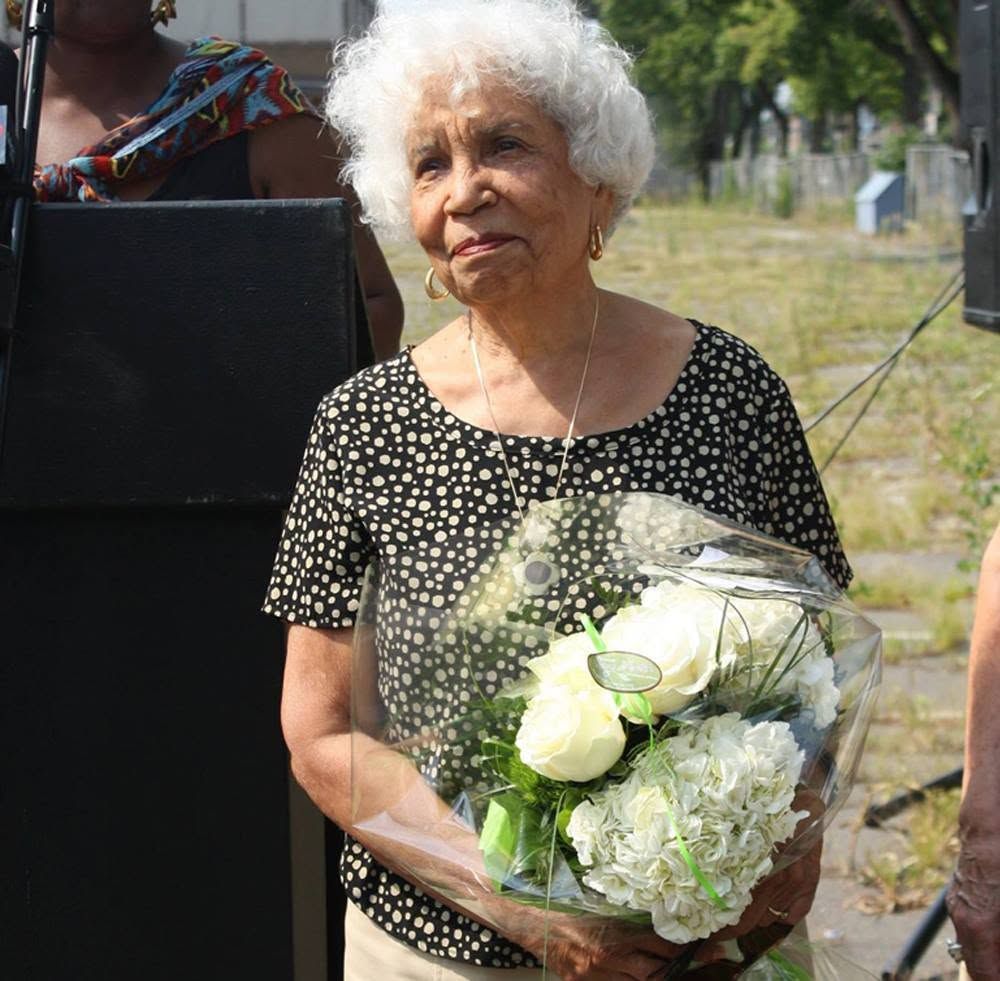 Adeline Magloire-Chancy, at the groundbreaking ceremony for the reconstruction of the Maison d'Haïti, in 2021
"That first Maison d'Haïti was already open to everyone," Adeline M-Chancy emphasizes from the outset. She still remembers that New Year's Eve when Chileans gathered at her home in 1973, following Augusto Pinochet's coup against socialist president Salvador Allende.
But first and foremost, Haitians in search of a place to belong were flocking to rue Champagneur in Montréal.
"I was alone. I had no place to rest or even to take a shower when someone told me: it's easy, just go to Max Chancy's place, he's a communist." — Dany Laferrière.
It is in these words that Dany Laferrière speaks of the origins of the Maison d'Haïti at the groundbreaking ceremony for the new building in 2021, before an audience of about a hundred people, including Adeline Chancy herself. "I was moved when Dany told that story," she confides to the newspaper.
"Max wasn't there when I arrived," adds the immortal. "His wife looked at me and I told her I needed a shower and five seconds later I was in the shower. Alone," the académicien clarified, to bursts of laughter from the audience.
Adeline Chancy, 89, remembers that "somewhat lost young man" who came knocking at her door in 1976. She already knew him through his articles in the "Petit samedi soir," a Haitian newspaper highly critical of the Duvalier dictatorship.
"I saw a young man coming who had dared to say no," recalls the octogenarian. "These young journalists who had the audacity to be somewhat dissident fascinated me." And that bold young man has come a long way: passing through Montréal, he has now arrived at the Académie française. And for Adeline Chancy, having helped him upon his arrival in Montréal was "a privileged moment of solidarity," she says humbly.
798 Champagneur
"Even the Duvalierists knew that address," says Ms. Chancy with a burst of laughter when the address of the building that represented the first "Maison d'Haïti" is brought up.
Everything was debated there, particularly politics. The gatherings at "7-9-8" made it possible to welcome "those who needed to be welcomed," to comfort them, and to reflect on the future, with an eye toward a new Haiti.
That first Maison d'Haïti was already open to everyone. Vietnamese people fleeing the war also found comfort at "7-9-8."
Having arrived in Montréal in 1965, fleeing the Duvaliers, Adeline Magloire Chancy, her husband Max, and their three young children were already sharing what they had with immigrants.
Yet these political refugees, who already had family in Montréal, had no papers. They spent 17 years in limbo, under the constant stress of possible deportation at any moment. Even Pierre Elliott Trudeau's "Mon pays" operation did not grant them asylum. Adeline Chancy did not receive her residency card until 1982.
History
1972: A group of young Haitians presents a summer project to the Canada Employment Centre. A small grant is awarded to them to provide reception, support, interpretation, and settlement assistance services to a Haitian population that had just arrived in Montréal.
These visionary young people set up in a small office at the YMCA on avenue du Parc, where they gave birth to the Maison d'Haïti. This project, which these young people had called the Projet Maison d'Haïti, was obviously not discontinued at the end of the summer of '72. Charles Dehoux, Nirva Casséus, and Pierre Normil are the three signatories in 1973 of a corporation that we would henceforth know as the Maison d'Haïti.
1983: The Saint-Michel neighbourhood becomes its home base, as a large population of Haitian origin had chosen to settle there. This dusty neighbourhood, abandoned to the incessant comings and goings of Montréal's garbage trucks, would gradually be transformed, thanks to the involvement of many families and the work of the community organizations and institutions that established themselves there.
Eventually, a major revitalization project in which the Maison d'Haïti actively participated would permanently change the face of the neighbourhood. Today, the organization welcomes families from every corner of the globe, people who have come seeking asylum and a future in this wounded, gutted neighbourhood, which nonetheless welcomes them with generosity.
Among the individuals who have left their mark on the Maison d'Haïti, instilling values of democracy, solidarity, openness, and sharing, mention must be made of Ernst Gresseau, Max Chancy, and Adeline Magloire-Chancy. These three figures, accompanied by a team of equally motivated young activists, literally forged the DNA of the Maison d'Haïti.