
Rony Sanon responds to "Kwentab"'s remarks
Rony Sanon ·
Faced with what they consider misleading claims, community members are recalling historical, demographic, and political facts that were overlooked in the broadcast.
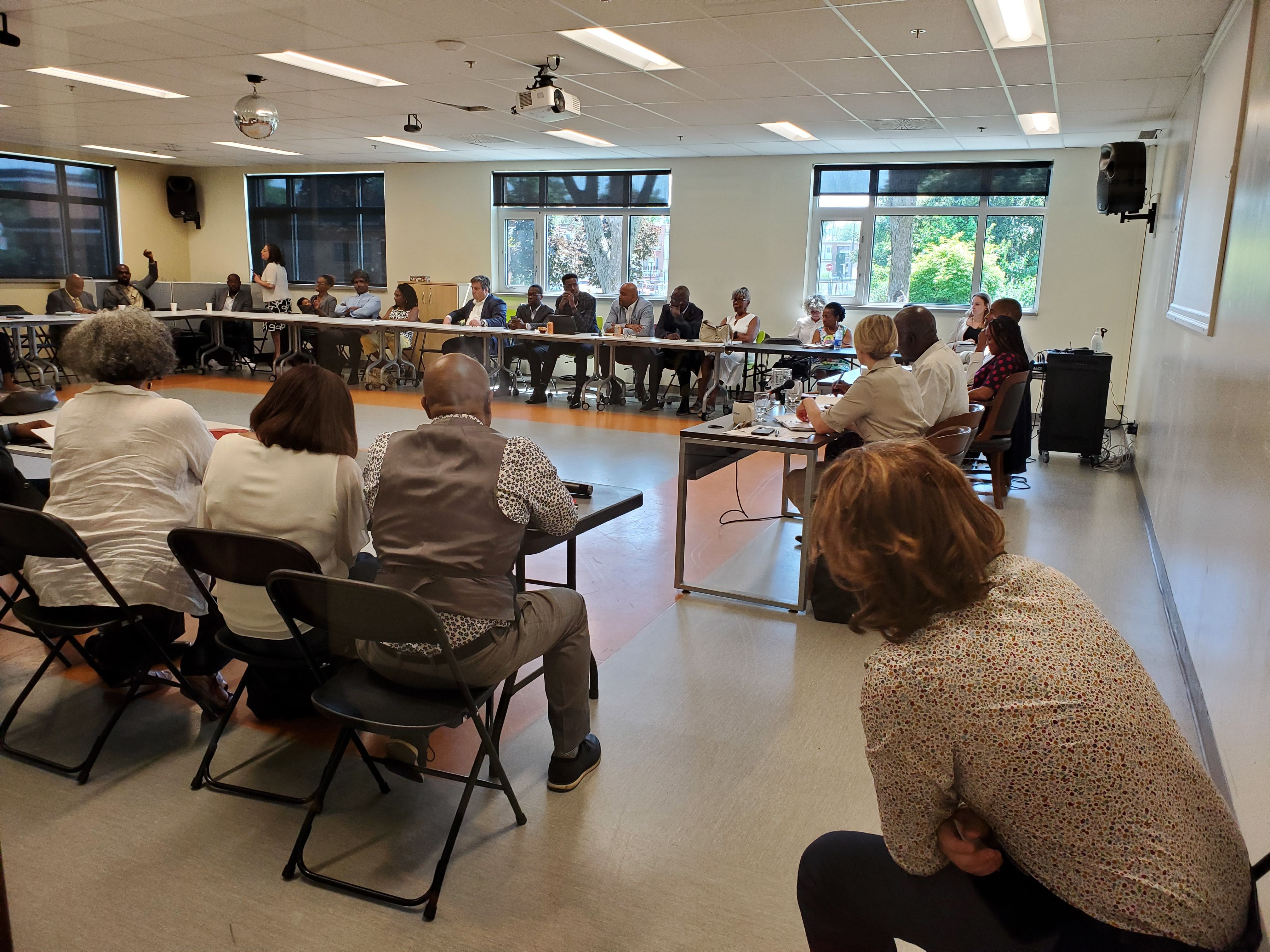
A clip from the show Kwentab, hosted by Loubert Meyer, has been circulating on social media for the past few days. At the 1 hour 26 minute mark of the interview, the host claims that Canadian parliamentarians of Haitian origin "do nothing" and that "we are not a community." He also states that the Ukrainian community in Canada has "150,000 members."
These remarks immediately sparked strong reactions within the Haitian diaspora in Canada, with many members denouncing what they describe as "false," "simplistic," and "misleading" statements. Having watched the interview in its entirety, I wish to set the record straight on several key facts, supported by official data and the recent history of Haitian mobilization in Canada.
An inaccurate demographic comparison
The host claims that the Ukrainian community in Canada has "150,000 members." However, official data from Statistics Canada directly contradicts this claim. According to the 2021 Census, the Ukrainian community represents more than 3% of the Canadian population, approximately 1.4 million people — nearly ten times more than what the host suggests. Source: Statistics Canada — 2021 Census
This community is one of the oldest in the country: its immigration dates back to 1891, giving it a historical presence of more than 130 years. Source: Library and Archives Canada
By contrast, people of Haitian origin represent approximately 0.5% of the Canadian population, with a much more recent immigration history concentrated in a few metropolitan areas. Comparing the two communities without accounting for these demographic and historical realities lacks any logical basis.
What is a diaspora?
A diaspora refers to a community of nationals living abroad, bound by a common origin and a sense of belonging that persists across borders. It may be organized or not, but it exists as long as a group shares an identity, a history, and ongoing ties with its country of origin.
As such, the Haitian diaspora in Canada undeniably exists. It is real, active, structured, and in motion.
The 2010 earthquake: an unprecedented mobilization
To measure the strength of a community, one must observe its capacity to mobilize in critical moments. The earthquake of January 12, 2010 in Haiti was a powerful testament to Haitian solidarity in Canada.
Frontline institutions
The community's flagship organizations — La Maison d'Haïti, the BCHM, and Centre Na Rive — with a combined history of over 150 years, supported grieving and devastated families.
La Perle Retrouvée became a gathering place for the entire community. Ministers and the then-Premier of Quebec came there to meet with affected families.
Regional associations mobilized
Organizations such as ASA (Association Aquinoise) built schools and health centres in Haiti. The AMHE (Association des Médecins Haïtiens à l'Étranger) carried out humanitarian missions alongside the Canadian Red Cross.
Haitian doctors played a crucial role: they translated for foreign medical teams to prevent unnecessary amputations caused by language barriers. They also contributed to the reconstruction of the Saint-Michel de Jacmel hospital.
Concrete political action
Contrary to the statements made on the show, elected officials of Haitian origin played a decisive role in several humanitarian and immigration matters.
2010 — Special immigration measures following the earthquake
Following the January 12, 2010 earthquake, the Government of Canada adopted special immigration measures in response to the humanitarian crisis. Official source: Government of Canada
In this context, former provincial member of parliament Emmanuel Dubourg (PLQ) asked his government to:
• accelerate the processing of pending immigration files;
• create a special program to welcome families from affected areas;
• broaden the criteria to include brothers, sisters, nephews, and nieces.
Thanks to this intervention, more than 10,000 families were welcomed into Canada. While the Haitian diaspora in the United States was requesting TPS, Haitians in Canada were obtaining permanent residency. Seventeen years later, Haitians in the United States still live under precarious status. The Haitian diaspora in Canada, on the other hand, secured lasting measures.
2016 — Regularization of undocumented individuals
Following the 2015 elections, Emmanuel Dubourg was elected federal member of parliament for Bourassa. In 2016, he undertook efforts that led to the regularization of more than 2,000 undocumented Haitian nationals. The Minister of Immigration even authorized the submission of files on credit, removing financial barriers.
2017 — Border crossing crisis
Faced with threats to TPS in the United States, thousands of Haitians crossed the border. A crisis committee made up of professionals, non-profit organizations, and Haitian elected officials was established to welcome these nationals with dignity. This committee met with the then-Prime Minister of Canada.
2019 — Protection against deportations
An administrative measure was adopted to prevent the deportation of Haitian nationals to a country in crisis.
2023 — Joint humanitarian measures
The Biden and Trudeau governments granted:
• more than 5,000 permanent residencies in Canada;
• a renewable program in the United States, complementing TPS.
A diaspora consulted on Haitian affairs
During the political and social crisis in Haiti, consultations were held with the Prime Minister of Canada and Ministers of Foreign Affairs. The Canadian Parliament held hearings in which Haitians from Montreal and Haiti participated.
The diaspora's recommendations appear in the official report of the Parliament of Canada:
The political mobilization in Montreal also played a role in challenging the visit of former Haitian president Michel Martelly, whose entry into Canada had been called into question by influential community members, supported by parliamentarians. Source: Radio Canada
This political dynamic enabled the community to achieve historic Senate representation: two senators of Haitian origin, who have become role models for young people, particularly for girls.
The Haitian community is not without its flaws, and each generation faces its own challenges. However, the remarks made at the 1 hour 26 minute mark of the show Kwentab reflect neither reality, nor the facts, nor history. They needlessly undermine the confidence, mobilization, and political participation of our members.
My intention is not to confront anyone. This episode of the show simply gave me an opportunity to recall facts that are true, documented, and essential, in order to restore a truth that cannot be ignored.
It would be worthwhile for the host to invite experts such as Jean-Claude Icart or Frédéric Boisrond, to further explain the history, challenges, and strengths of a community that, while imperfect, is dynamic and rich in resources.
The Haitian diaspora in Canada is a strong, organized, united, and influential community. It has demonstrated this in the most difficult of times. It continues to do so every day.
Rony Sanon Political Attaché Advocate for Representation