
Montreal-Nord: the blind spots in SPVM recruitment
Jean Numa Goudou ·
Exam, interview, background check. "We do all of that, but how did it slip past us?" - Fady Dagher
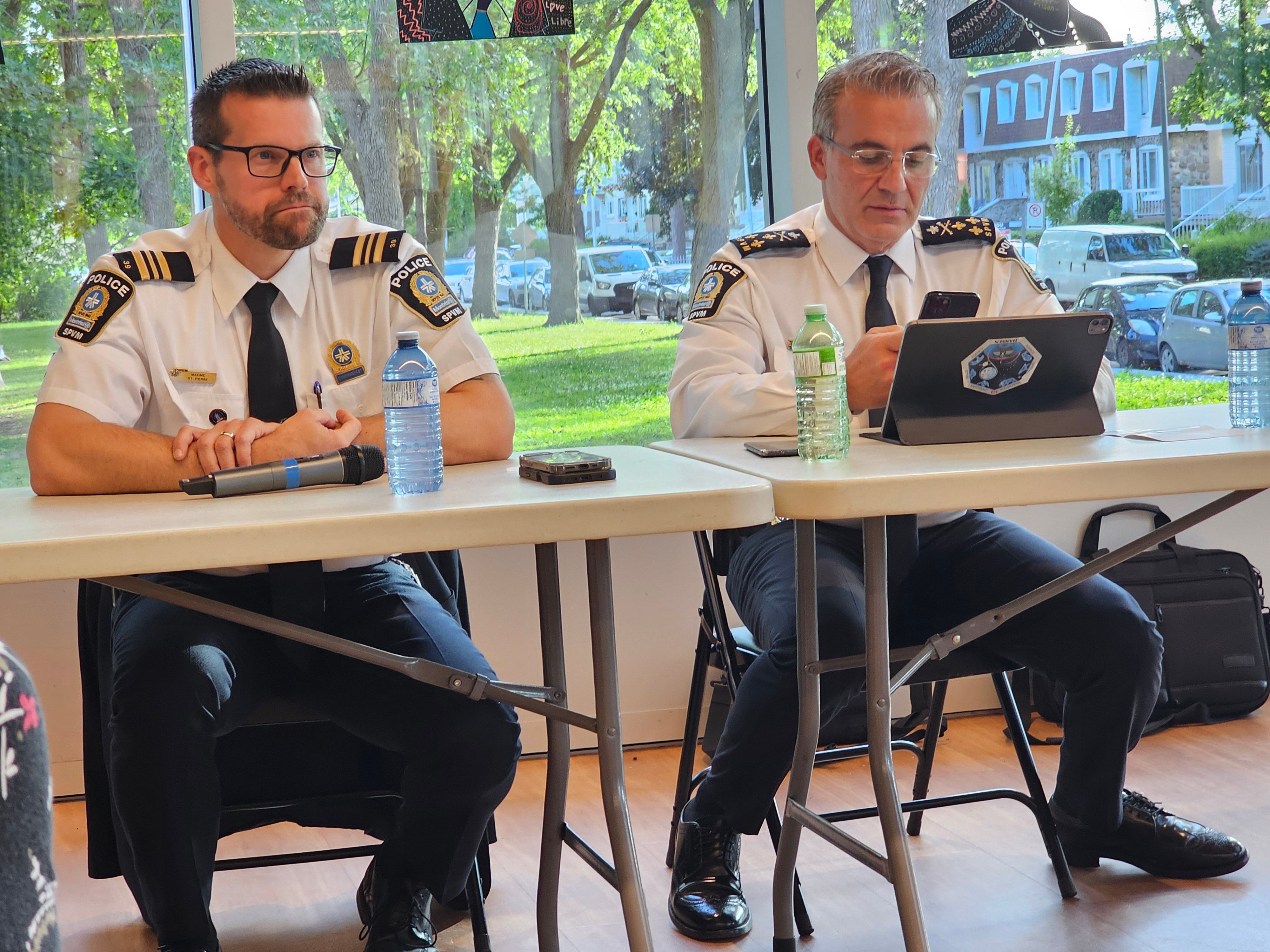
After the media and community organizations, it was the turn of ordinary citizens to be given the floor by the Service de police de la Ville de Montréal (SPVM) to ask questions about Station 39, in Montréal-Nord. Fady Dagher himself made the trip for a meeting on Pascal Street, flanked by the brand new commander Maxime Saint-Pierre, replacing Hélène Mercier who retired in the wake of the events.
The SPVM chief repeated what had happened and confirmed what the public had learned through the media. "Pretty much everything you saw and heard in the media is true," Mr. Dagher told them before opening the floor to questions.
The first question came from Mariam St-Pierre, a white resident of Montréal-Nord, apparently in her seventies. She asked the police chief to remind her of the number of years of service of the officers involved in dehumanizing acts, such as "pulling and cutting the hair" of Black people under their control. "On average 3, 4 or 5 years, no more," Fady Dagher responded politely, as usual.
"But," Ms. St-Pierre followed up, "before becoming a police officer, aren't people taught what racism is? It's still incredible that this happens like this…"
The SPVM chief took a breath and began to list a series of provisions and measures that accompany the recruitment process within the police force: examination, interview, background check, "these kinds of verifications, we do them," he assured.
There is even a simulation following hiring, and an immersion project (meetings with communities to understand their culture) is carried out with recruits.
"But I will be frank with you, we are conducting an introspection. We do all of this, but how did it slip through our fingers?" the police chief wondered. "We are looking at what the blind spots were in these programs," concluded Mr. Dagher in his response to the resident.
Carmen L'Heureux, another white resident of Montréal-Nord, had the same questions. "I find it distressing, these young officers… We really need to address this because it is difficult to understand," she said, "how is it that despite all the training provided, some still slip through the system?" she lamented.
"The good news is that it was police officers who reported other police officers," the police chief simply noted, reminding those present that from now on, it is three and not two officers out of the 16 who are facing criminal charges.
Meanwhile, the Black and Arab residents present at the meeting, who are three to four times more likely to be stopped, raised questions related to the DPJ, immigration, and their interactions with police.
Since the beginning of the SPVM investigation, around twenty calls from the public, as well as from officers internally, have been made to the internal investigations bureau. All information provided is currently being analyzed.
"What I received as information, but especially as evidence, constitutes extremely solid evidence," Fady Dagher confided to the residents of Montréal-Nord on Wednesday during the meeting.
"I will ensure that there are very serious consequences for these three individuals if they are found guilty." - F. Dagher.
It should be recalled that the team of approximately fifteen officers involved in these reprehensible acts has been replaced in the field. The officers currently working within this unit all volunteered for the assignment.
"Half of them have lived in, resided in, grown up in or attended school in Montréal-Nord and love Montréal-Nord," Fady Dagher noted, indicating that a change in approach is being put in place.
Furthermore, an immersion project for all officers at Station 39 is currently being studied within the SPVM.