
Leslie Voltaire and Edgard Leblanc Fils or the Last Cacos
Roger Romulus ·
Leslie Voltaire and Edgard LEBLANC Fils have publicly thanked Prime Minister Alix Fils-Aimé.
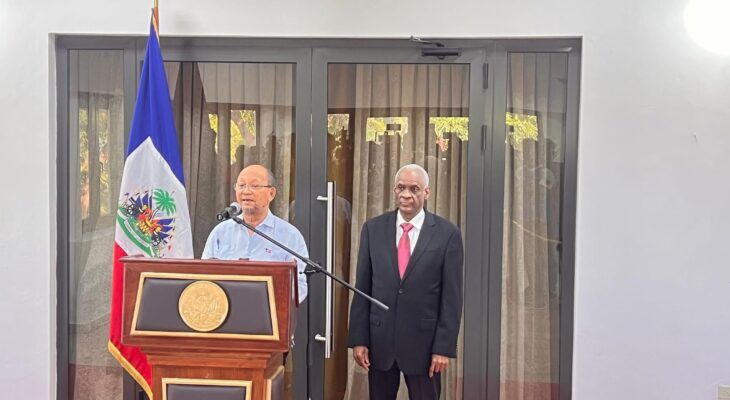
As the Transitional Presidential Council (CPT) goes through a turbulent period, Leslie Voltaire and Edgard LEBLANC Fils have publicly thanked Prime Minister Alix Fils-Aimé. A position that, by its firmness, recalls the legacy of the Cacos and revives the debate on national sovereignty in the face of international pressures.
In the Haitian imagination, the Cacos occupy a unique place: that of peasant resistance, fierce, undisciplined, but deeply attached to national sovereignty. The American occupation forces called them "bandits." Yet, for Haiti's history, they remain the actors who practically monopolized the armed, conscious and deliberate resistance to the North American occupation from 1915 to 1934. Their legacy remains a powerful symbol of dignity and refusal of foreign domination.
Today, as the country goes through a major political crisis, the evocation of the "last two Cacos" takes on particular resonance. It recalls the permanent tension between fragile institutions, the quest for order and the demand for national sovereignty.
A Presidential Council in search of legitimacy
Although the (CPT) can be reproached for having failed in its mission — as defined in Article 16 of the Agreement, which consists of putting Haiti back on the path of dignity, democratic legitimacy, stability and sovereignty, while ensuring the proper functioning of state institutions — it is essential to recall the context of its creation. When the international community claimed to want to encourage a "Haitian solution," it proposed a collegial presidency composed of nine members, each with a four-month mandate. An unprecedented political architecture, fragile and difficult to operate.
The Presidential Council's primary responsibility was to appoint a prime minister. Since its installation, it had already removed one, in accordance with the mandate entrusted to it. Yet today, various public messages from international actors express support for Prime Minister Alix Didier Fils-Aimé — support that, according to some observers, contributes to undermining the legitimacy of the CPT, even though this structure had initially been encouraged by these same actors.
The last two Cacos: a gesture of resistance
Two men, armed with courage, chose to stand tall despite tensions and pressures, and to summon the press to defend what they consider to be the last bulwark of democracy and dignity of the Haitian people. Their posture recalls that of Charlemagne Péralte and Benoît Batraville, two emblematic figures of Caco resistance, arrested and executed during the American occupation of 1915-1934.
Councilors Leslie Voltaire and Edgard LEBLANC Fils announced that the Council members had voted by majority in favor of the departure of Prime Minister Alix Fils-Aimé, in accordance with the powers that the CPT had received. Their public position, in the face of criticism and tensions, falls within a logic of symbolic resistance.
These two men — who can be symbolically called "Cacos" — participated in the 1990s in the struggles against coups d'état and for the return to constitutional order, alongside the current prime minister's father, former Pétion-Ville/Kenscoff deputy and former political prisoner Alix Fils-Aimé. Today still, they stand before the representatives of the international community to express their disagreement, like the Cacos of old, facing forces that sought to impose their will. The pressures and injunctions recall those suffered by the peasants who defended their rights.
A continuity of struggle
These two fighters from parties with popular and Haitian left-wing sensibilities have once again refused to submit. Their gesture is part of a long tradition of political and moral resistance. By recalling the memory of the Cacos, they assert that national sovereignty is not negotiable and that the dignity of the Haitian people cannot be sacrificed.
By standing up publicly against what they perceive as a drift, Leslie Voltaire and Edgard LEBLANC Fils recall a truth that Haitian history keeps repeating: when a country falters, it is not the fragile institutions that hold the line, but the women and men who refuse to bow down. Their gesture is not a simple political act; it is a brutal reminder that sovereignty cannot be delegated and that a people's dignity is never negotiable.
Like the Cacos of yesterday, they oppose a clear refusal, without ambiguity, in the face of pressures and injunctions. They recall that the nation is not governed by tweets, nor by veiled threats, but by coherence, courage and respect for commitments made before the people.
In a moment when everything seems to waver, their position cuts like a machete through the brambles: a clear no, a frontal no, a no that resonates. A no that says that Haitian sovereignty is not a facade, but a red line.