
Racism on the Internet: Statement from the Canadian Race Relations Foundation
Rédaction Intexto ·
When 71% of respondents declare having been victims or witnesses of racist or anti-immigrant remarks online, we are no longer talking about isolated incidents.
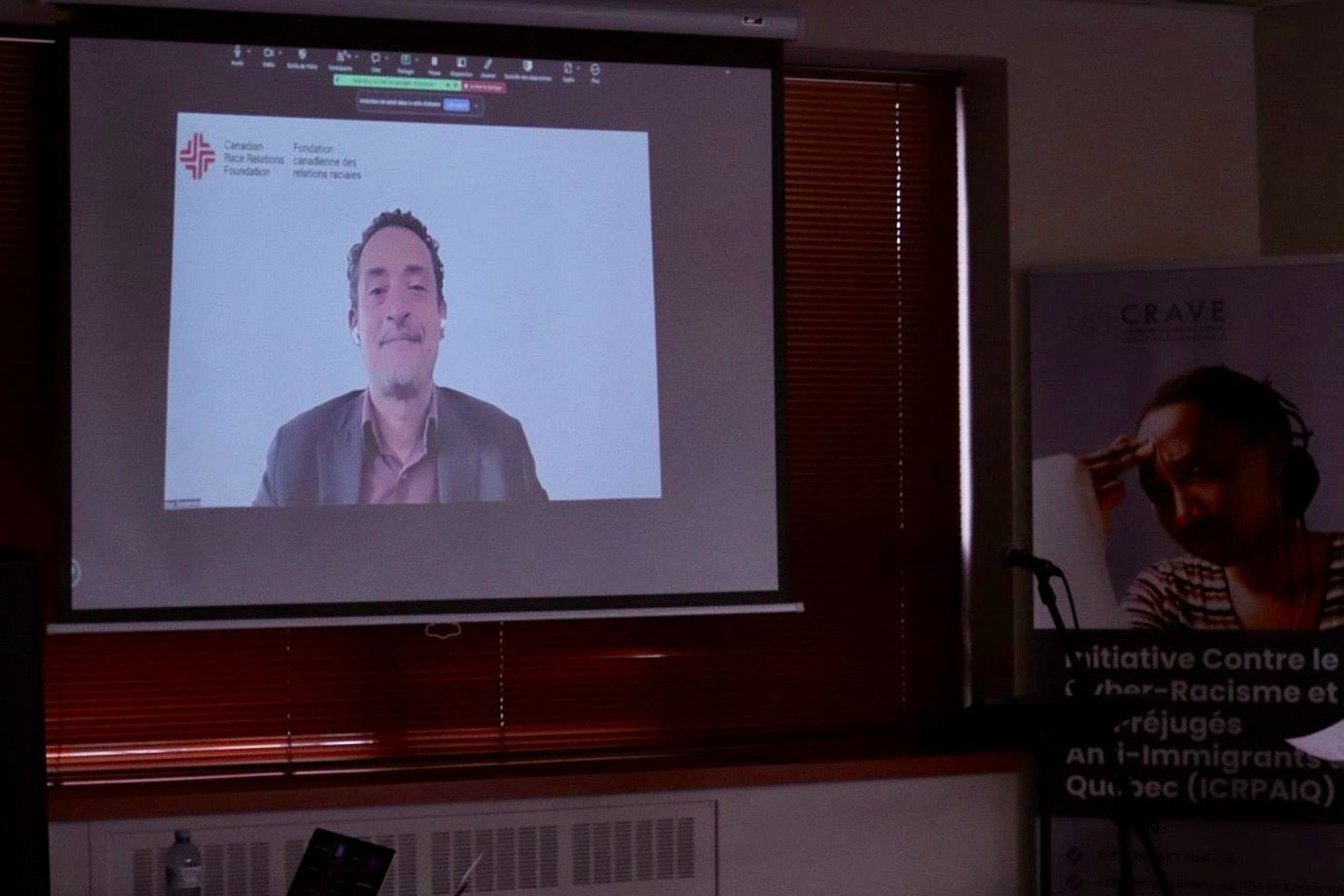
It is a great honor to speak before you today, as Quebec regional director of the Canadian Foundation for Race Relations. I regret not being able to be physically present, but I wanted to highlight the publication of essential research conducted by CRAVE with the support of the CRRF.
The results of the research conducted by CRAVE are both clear and concerning. This study shows us that cyber-racism in Quebec is neither marginal nor sporadic. It is frequent, multifaceted, and above all deeply rooted in the digital experiences of Black people.
When 71% of respondents report having been victims or witnesses of racist or anti-immigrant remarks online, we are no longer talking about isolated incidents. We are talking about a structural phenomenon that affects psychological health, sense of belonging, and self-confidence.
At the CRRF, these findings strongly resonate with our own work. In our national survey, Race relations in Canada: National survey on racism, discrimination, and social cohesion, we found that racism, whether experienced in person or online, remains a persistent reality in Canada. A significant proportion of racialized people report a deterioration of the social climate and a trivialization of hate speech.
Digital technology further amplifies these dynamics: algorithms, virality, anonymity — everything conspires to accelerate the spread of prejudice.
But behind the statistics, there are faces. There are voices. I think particularly of the powerful testimony of journalist and entrepreneur Carla Beauvais as part of our #BlockHate campaign with the Y des femmes. She courageously recounted the very concrete impact of racist attacks online: anxiety, emotional fatigue, but also the determination not to remain silent. Her story reminds us that cyber-racism is not virtual in its consequences. It is very real and its effects are felt within families and communities. Too often, online hate leads to hate in the real world. Examples in Quebec and the rest of Canada have unfortunately been numerous in recent years.
What this study reveals today is also a troubling paradox: 78% of those surveyed do not react to hate speech. Not out of indifference, but often due to exhaustion, fear of retaliation, or lack of confidence in protection mechanisms. This should concern us collectively. Because when part of the population resigns itself and accepts the unacceptable, democracy itself becomes impoverished.
Faced with this, our response must be systemic. It must highlight evidence-based data, as this research does. It must combine education with a firm legal framework for platforms, support for victims with citizen mobilization. This phenomenon affects all racialized communities, and our young people in particular. So, we must act together.
It is in this spirit that the CRRF organized, on February 25th, in collaboration with The Globe and Mail, a major event devoted to the Black Justice Strategy. It notably addressed the social determinants of justice and their direct and indirect impacts on Black people. This strategy constitutes an important step in recognizing and correcting the systemic inequalities that persist in Canada. It fits within the continuity of the International Decade for People of African Descent and represents a concrete commitment in favor of more equitable justice for all.
But beyond public policies, what gives me hope today is the mobilization of the communities themselves. In Quebec, we have seen coalitions of organizations rise up to document online hate, support young people, and offer safe spaces for dialogue. Citizen initiatives in high schools, CEGEPs, and universities are developing critical digital education workshops. Racialized content creators use social media to deconstruct stereotypes and reaffirm positive narratives.
On a Canadian scale, cities like Toronto, Halifax, or Vancouver have seen the emergence of consultation tables bringing together researchers, community leaders, police officers, and municipal representatives to better prevent hate crimes and their digital extensions. These efforts demonstrate that when communities, institutions, and media work together, concrete solutions emerge.
At the CRRF, we deeply believe in this collaborative approach. After organizing in 2024 a panel on online hate, the Quebec department will launch in 2026-2027 a series of podcasts devoted to online hate among young racialized Quebecers — its impacts, but especially the solution paths. Our mandate is clear: start from lived experience, transform community concerns into structured recommendations, and influence public policies in a lasting way.
Social media and artificial intelligence are not threats in themselves. They can be powerful tools for awareness-raising, mobilization, and social transformation — provided they are framed by clear rules and developed in collaboration with those who suffer their effects. As a fundamental principle of social movements says so well: "Nothing about us, without us."
Yes, the challenge is immense. But communities are organizing. Young people are speaking up. Researchers are documenting. Institutions are beginning to listen.
Together, we have the capacity to transform Quebec's digital space into a space of dialogue rather than division. Not by denying difficult realities, but by confronting them collectively, with courage and solidarity.
I want to warmly congratulate CRAVE and all the researchers and partners involved. Your work contributes to making visible what was too often normalized — and that is the first step toward change.
Let us continue to act, together. For our young people. For our communities. For a Quebec and Canadian society that is more just, more inclusive, and more resilient.
Thank you.
Neal Santamaria