
"You are a little kid": an SPVM officer insults him in Creole and is convicted
Jean Numa Goudou ·
On February 8, 2024, around 11:30 p.m., Johnny Lerouge was in the process of closing his restaurant when the incident occurred.
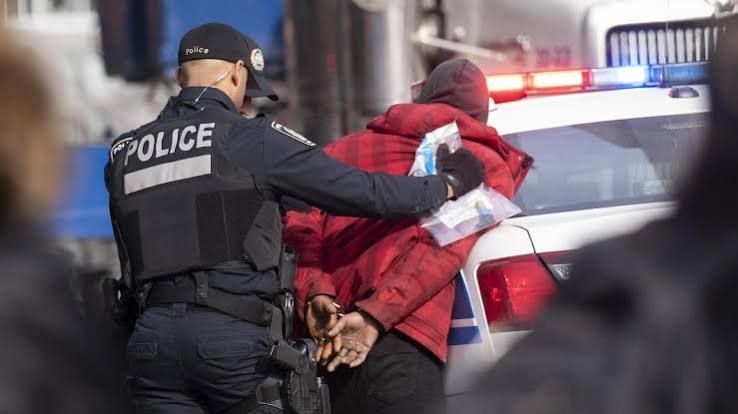
The Tribunal administratif de déontologie policière has just imposed an 8-day suspension on officer Desjardins Bélisle for violating Article 5 of the Code of Ethics.
Officer Desjardins made remarks based on race, color, and ethnic origin, saying to Mr. Johnny Lerouge: "Arrête de faire tes macaqueries comme un esti d'enfant" and "Tu es un ti moun, tu es un ti moun, tu es un ti moun," in Haitian Creole.
The decision also concludes that officer Desjardins Bélisle used abusive language and showed a lack of respect and courtesy toward Mr. Johnny Lerouge by saying "Mange de la marde" and "je m'en câlisse, mon argent est légal."
"After hearing the parties, the Tribunal decides to impose a sanction of an 8-day suspension," the Tribunal states.
Background
On February 8, 2024, around 11:30 p.m., Mr. Lerouge was closing his restaurant. He has Black skin. Just before leaving, he remotely started his vehicle, a Cadillac. The car is equipped with a camera that records automatically when the vehicle is started.
Meanwhile, officer Desjardins Bélisle, accompanied by his colleague officer Samuel Lalonde, was on duty during the night shift. They are members of the Éclipse squad, the unit mandated to conduct surveillance at licensed alcohol establishments in order to counter organized crime, armed violence, and street gangs. As such, officers Desjardins Bélisle and Lalonde had just completed checks at a bar when they spotted Mr. Lerouge's vehicle running but unoccupied.
That evening, the officers were also patrolling and running checks on several license plates of vehicles circulating in the area through the Centre de renseignements policiers du Québec (CRPQ). After pulling over one vehicle for that purpose, the officers returned to where Mr. Lerouge's vehicle was parked.
They again noticed the presence of Mr. Lerouge's vehicle. This time, Mr. Lerouge was at the wheel and moved it a few meters before immediately getting out. Johnny Lerouge simply wanted to remove an empty food box that had been accidentally left on the roadway. Once the box was picked up, Mr. Lerouge headed to the back of his restaurant and placed it with the rest of the garbage.
Officer Desjardins Bélisle, who was driving the patrol vehicle, found Mr. Lerouge's behavior "suspicious" and drove to the entrance of the restaurant's parking lot, where he stopped him.
The officers asked Mr. Lerouge to identify himself, which he initially refused to do. A heated argument followed. Mr. Lerouge expressed his disagreement and insulted the officers while shouting.
After Mr. Lerouge repeatedly refused to identify himself, officer Desjardins Bélisle informed him that he would have three seconds to identify himself, failing which he would be arrested. Mr. Lerouge eventually revealed his first and last name.
Shoddy work
While officer Desjardins Bélisle was running checks through the CRPQ and moving the patrol vehicle in front of Mr. Lerouge's car, officer Lalonde accompanied Mr. Lerouge to his vehicle to retrieve a folder containing his insurance and registration documents, as well as his driver's license. Officer Lalonde then rejoined his colleague in the vehicle to write up infraction tickets.
At a certain point, both officers got out of the patrol vehicle. Officer Desjardins Bélisle approached the passenger-side door to hand Mr. Lerouge four infraction tickets — for having left a stationary vehicle's engine running for more than three minutes, for emitting a noise audible outside the vehicle, and for failing to have proof of insurance and his registration certificate in his possession.
Immediately, Mr. Lerouge confronted him, stepping out of his vehicle and walking toward the driver's side door of the patrol car. According to Mr. Lerouge, the officers had never asked him to produce those documents. Furthermore, if they were expired, as officer Desjardins Bélisle had told him, the officers had not checked with him whether he had valid ones — something the officers acknowledged.
Officer Desjardins Bélisle did not hold back, however, and in turn made abusive remarks, showing a lack of respect and courtesy, and making comments based on race, color, and ethnic origin toward Mr. Lerouge — remarks for which he acknowledged, in some cases, his ethical responsibility, while for others, the Tribunal found his conduct to be in violation of the Code.
"In a society that strives to be inclusive, just, and egalitarian like ours, it is undeniably unacceptable that racially charged remarks could be made in 2026. Respect, equality, and dignity are fundamental values with regard to every citizen, regardless of race, color, or ethnic origin," the Tribunal writes in its judgment.
The judge further finds that "an ethical violation of this nature is therefore objectively serious."
Excerpts from the judgment
"This is to say nothing of the consequences it brings, which are invisible but no less significant. First, as the Tribunal wrote in its decision on the merits, race-based remarks convey stereotypes and prejudices, in addition to humiliating and causing harm, so that those who are victimized by them come to fear for their safety, which creates distrust toward law enforcement. Incidentally, this undermines public confidence not only in the offending officer, but in all officers."
"It is true that making remarks based on race, color, and ethnic origin and racial profiling can both raise issues of discrimination. Moreover, both forms of conduct are prohibited under Article 5 para. 2 (4) of the Code. However, they refer to two different realities. Indeed, racial profiling consists primarily of an intervention influenced by racial considerations rather than objective and reasonable grounds, while race-based remarks refer to words or comments alluding to a person's race, color, or ethnic origin."
"In the first case, police conduct involves an unjustified misuse of police power akin to an abuse of authority, which has often been considered objectively more serious by case law, given the tangible repercussions on citizens that infringe upon their fundamental rights, namely arrest, detention, and, in some cases, the use of force."
"The Tribunal does not assert that sanctions related to race-, color-, or ethnic origin-based remarks could never approach those in cases of racial profiling. However, in the present case, the circumstances do not justify it. That is why the Tribunal does not align with the position the Commissioner would prefer, namely that the sanction should be closer to those imposed in cases of racial profiling."