
"Better understanding the injustices experienced by Black professionals in rehabilitation"
Rédaction Intexto ·
A conference by Cindy Louis-Delsoin (erg., M. Sc., PhD(c)) on the subject
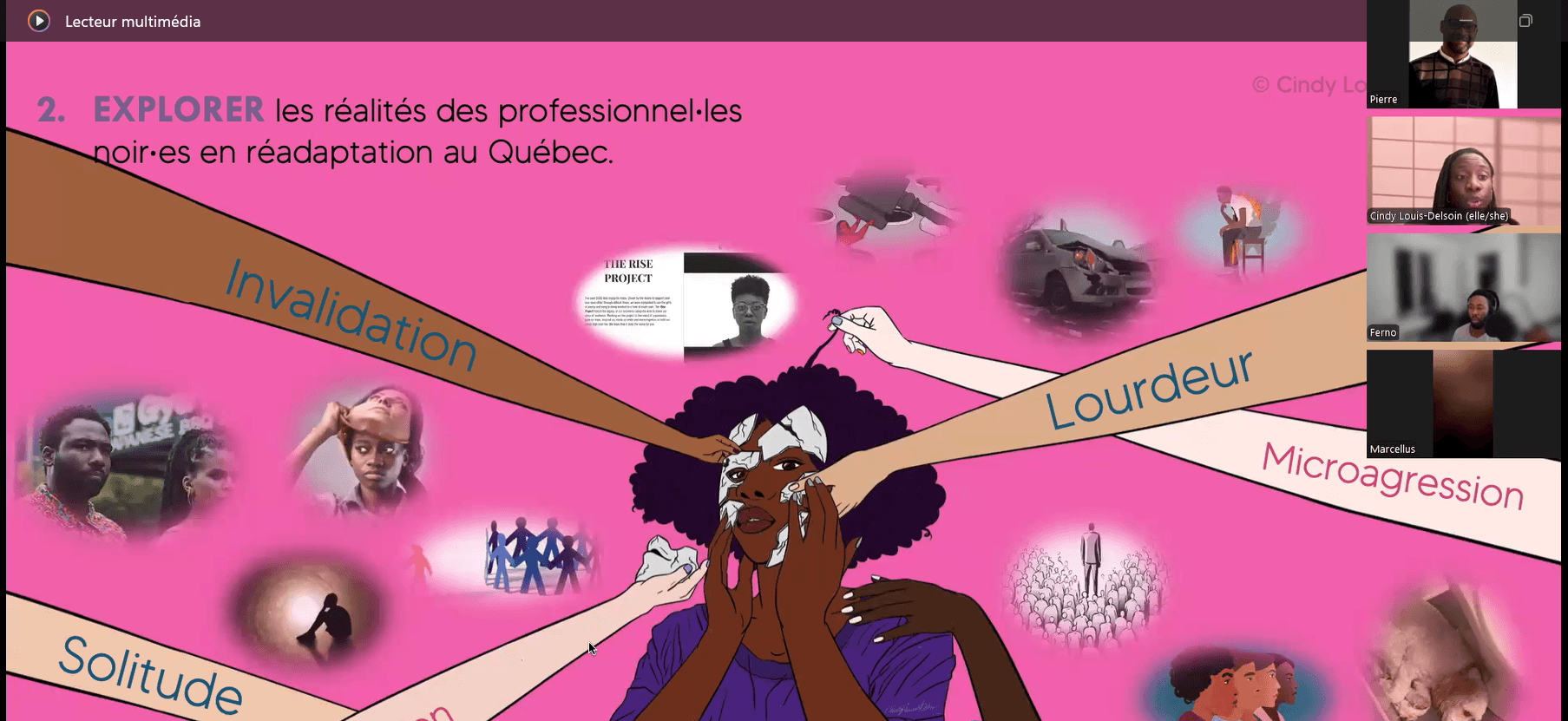
It was the organization LAKAY that presented this conference by Cindy Louis-Delsoin (erg., M. Sc., PhD(c)) as part of Black History Month. From the outset, Ms. Louis-Delsoin invited participants to distinguish between "injustice" and "discrimination."
She pointed out that injustice is not limited to intentional acts and explained that certain injustices are linked to power imbalances, violations of rights, and multifactorial mechanisms that produce inequalities.
To illustrate her point, she used the example of waiting lists: the same system can generate inequitable outcomes, even when no one is explicitly "targeting" a particular group. Through a structured and accessible presentation, the speaker offered concrete reference points to help healthcare settings — and rehabilitation in particular — to better identify, recognize, and address realities experienced in the field.
The conference then placed these issues within a broader perspective, recalling that anti-Black racism has a well-documented history within the health professions. Cindy Louis-Delsoin presented elements from the literature showing that, despite progress, the access, recognition, and advancement of Black individuals have long been hindered in Canada, leaving marks on institutional cultures and contemporary practices.
At the heart of the event, the speaker shared insights from her research in rehabilitation — an ongoing doctoral project — which aims to explore the realities of Black rehabilitation professionals in Québec.
She proposed a three-dimensional analytical framework: racial, epistemic, and systemic injustices. Within this framework, she identified lived experiences that are frequently reported and recognized in workplaces: loneliness (feeling excluded), burden (being constantly on guard, carrying a "racial load"), and invalidation (indifference or minimization by professional peers).
Regarding discrimination, she distinguished between microaggressions (pejorative stereotypes, clumsy gestures, intrusive curiosity) and macroaggressions, such as heightened surveillance and pressure to assimilate.
Finally, Cindy Louis-Delsoin emphasized the importance of moving from observation to action. She proposed Afro-emancipatory initiatives to address these issues: networking, association-building, awareness-raising, youth projects, podcasts, and organizational policies — without forgetting the space needed for "Black joy" as a force for resilience and rebuilding. The conference concluded with a clear call to action: to multiply reflections, but above all to commit to measurable, lasting actions co-constructed with the people concerned.
Let us recall that this conference was organized by LAKAY as part of Black History Month in Lanaudière, a regional program that highlights the heritage, contributions, and contemporary realities of Black communities, while opening spaces for dialogue and transformation.