
9th Youth Summit: Communities Challenge Politicians
Jean Numa Goudou ·
For its 9th edition, the event offers a space for reflection, dialogue and mobilization
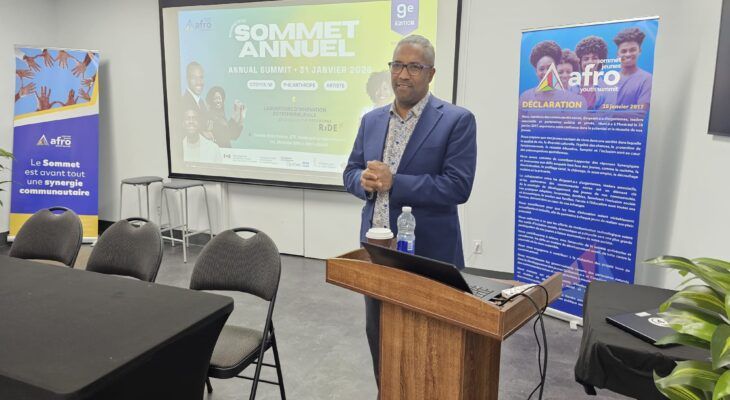
The 9th Black Communities Youth Summit opens this Saturday, January 31 at the Grande bibliothèque de Montréal, at 475 Boul. de Maisonneuve Est (Berri-UQAM Metro) starting at 8:30 a.m., in the presence of several elected officials and public figures including Canadian Minister of Health and Papineau MP Marjorie Michel.
For its 9th edition, the event offers a space for reflection, dialogue and mobilization around three structural axes: civic participation, community philanthropy and cultural expression, envisioned as essential levers for social transformation and collective development.
On this occasion, the Summit, through its Observatoire des communautés noires du Québec (OCNQ), plans to present, in collaboration with the Fondation du Grand Montréal (FGM), the report "Vital Signs: Philanthropy and Black Communities of Quebec."
This unprecedented study offers an in-depth look at participation, practices and philanthropic perceptions within Quebec's Black communities. It highlights the diversity of forms of giving, mutual aid and engagement, often rooted in strong community and cultural traditions.
Beyond the findings, this publication invites us to rethink philanthropy from an inclusive perspective, where recognition of Black contributions becomes an essential lever for equity and social transformation.
Open letter to politicians
The Observatoire has drafted an open letter addressed to politicians, inviting them to take more responsibility in their positions and public statements. Young people and the public will be invited to comment on and potentially sign the missive inspired by statements from Parti québécois leader Paul Saint-Pierre Plamondon.
In interviews with several media outlets in July 2025, the PQ leader linked the rise in crime in Quebec to increased immigration.
"Twenty years ago, before the demographic changes generated by immigration, we would never have thought that criminal groups could be so aggressive in identifying young people, from the age of 12-13, to turn them into active criminals capable of murder by age 16. We must acknowledge this," the Parti québécois leader told the Journal de Montréal in an interview on LCN.
Only the Parti libéral du Québec had countered what he was claiming. The PLQ's public safety spokesperson, Jenifer Maccarone, called PSPP's statements irresponsible.
"Such points that are conveyed in the media and in the public sphere must be based on facts, research, data, and I haven't seen any of that to date. So it seems to me that he is dividing the population," she said.
Impact on collective consciousness
The Summit's letter, which is addressed to all politicians, particularly PSPP, invites politicians to address these issues in the public space with more "responsibility," notes Summit president Édouard Satco.
Before drafting the letter, the Observatoire conducted a study on the subject which reveals that "there is no link between immigration and crime, quite the contrary."
"The letter recalls the need that when someone, a political party leader, speaks in the media, it has an impact on the collective consciousness and that one must not assume facts like that and that one must base oneself on real data," indicates the Observatoire's deputy director, Melissa Macena.
The 2026 edition will also be marked by the presentation of the Laboratoire d'innovation entrepreneuriale, a dynamic space fostering the emergence of entrepreneurial initiatives, economic creativity and the sharing of experiences from Black communities across Quebec.
This day will present the achievements of the Sommet Jeunes Afro, share upcoming development perspectives and discuss concrete action plans aimed at strengthening inclusion, equity and civic participation. These reflections and contributions are fully in line with a vision of sustainable and inclusive development for Quebec.
Program:
Accountability report from the Sommet Jeunes Afro.
Presentation of research results.
Thematic panels on topics including:
Culture as a vector for mobilization: creation, memory and expression.
Identity and future: how Black people are transforming culture in Quebec.
Spaces for exchange and dialogue among participants.
5 to 7 networking event to close the day
Certain parts of this event may be recorded. By participating, you understand that your image may be recorded and used in future promotions and communications.